1.Introduction
The transition into medical residency concentrates a well-characterized set of occupational hazards: chronic sleep deprivation, high-density clinical decision-making under supervision constraints, and an abrupt shift from the classroom to overnight on-call responsibility.[1] These conditions carry a measurable clinical burden. In a meta-analysis of 17,560 residents from 47 countries, Mata and colleagues estimated a pooled prevalence of depression of 28.8%, rising by roughly 0.5% per additional year of training.[2] A 2025 scoping review confirmed that this burden has remained elevated a decade later, with a consistent female predominance.[3] For hospital administrators, these figures are not merely a clinical concern of the psychiatry service; distress and burnout in the clinical workforce are associated with reduced professional performance, absenteeism, turnover, and threats to patient safety.[4]
The World Health Organization’s 2022 framework on mental health at work explicitly positions the prevention and early detection of psychological distress as an employer responsibility and a component of organizational risk management, rather than a purely individual matter.[5] Yet in most postgraduate training institutions the moment of highest structural risk—the entry of a new cohort into clinical duty—passes without any systematic assessment of the incoming workforce’s mental health.[6] The induction window is the single point in the academic year at which the entire incoming cohort is assembled, before the first overnight shift, the first patient death, and the steep technical learning curve amplify latent symptoms. From a management perspective, it is also the most efficient control point at which to identify, triage, and route at-risk personnel before unsupervised clinical responsibility begins.
The Mexican context reinforces the operational relevance of early detection. National estimates place anxiety prevalence among residents between 39% and 70% across specialties and regions,[7,8,9] and suicide risk among trainees varies significantly by specialty and training year.[10,11] Detecting a resident with severe depression or active suicidal ideation before the first on-call shift is therefore not only a clinical imperative but an institutional risk-mitigation measure with implications for medical-error prevention, workforce continuity, and the institution’s duty of care toward its personnel.
We selected the Patient Health Questionnaire-9 (PHQ-9) and the Generalized Anxiety Disorder-7 (GAD-7) because both meet the essential requirements for a scalable induction-day instrument: brevity (under five minutes combined), robust psychometric performance (PHQ-9 ≥ 10: sensitivity 88%, specificity 88%; GAD-7 ≥ 10: sensitivity 89%, specificity 82%), validation in Spanish, and free availability at no licensing cost.[12,13] In this report we describe the design, implementation, and first-cohort outcomes of an institutional quality-improvement program built around these instruments, and we evaluate it against four operational objectives: (1) feasibility of universal screening during mandatory induction; (2) organizational acceptability; (3) identification yield, including residents at risk of self-harm; and (4) adherence to an automated, time-sensitive referral pathway. Reporting follows the Strengthening the Reporting of Observational Studies in Epidemiology (STROBE) guidance for the observational component.[14]
2.Methods
2.1Program design and implementation framework
The program was designed by a multidisciplinary team within the institutional liaison psychiatry service, comprising consultant psychiatrists, senior psychiatry residents, and the residency program coordinator. Rather than a curricular activity, the workflow was designed as an institutional clinical protocol, mapping the administrative steps from baseline identification to proactive resource allocation: problem definition, instrument selection, integration into the existing mandatory induction agenda, and the operational rules governing the downstream referral pathway. An internal 2023 review had found that 36% of residents reported never having been formally screened for depression or anxiety during training, and focus groups with chief residents from medicine, surgery, and pediatrics confirmed both the perceived need and the acceptability of an anonymous, institution-led process. The protocol was piloted in the 2023 cohort and refined for full implementation in 2024.
Alternative instruments (Beck Depression Inventory, Hospital Anxiety and Depression Scale) were considered but not adopted, because the PHQ-9 and GAD-7 offered shorter completion time, no licensing cost, validation in Spanish-speaking populations, and a direct mapping to clinical decision thresholds that could be operationalized as automatic referral triggers.
2.2Institutional setting and workforce population
The program was implemented during the mandatory two-day institutional induction of a national high-specialty public teaching hospital in Mexico City, the only point in the academic year at which the entire incoming cohort across all specialties is convened. The target population is approximately 200 incoming postgraduate residents annually, drawn from internal medicine, surgery, pediatrics, anesthesiology, psychiatry, radiology, and surgical subspecialties. Personnel enter with widely varying mental-health literacy and no prerequisite preparation. The program required one lead liaison psychiatrist as program coordinator plus two clinical staff, and used the hospital’s existing auditorium, projection equipment, and induction schedule; no additional dedicated facilities, licenses, or budget lines were created.
2.3Screening procedure
The 30-minute standardized session was delivered within the day-1 induction plenary. After a brief framing that emphasized voluntary, anonymous participation and the explicit assurance that no academic record would be generated, participants scanned a projected QR code with their personal devices and completed the PHQ-9 and GAD-7 (16 items) on an anonymous digital form configured to store no identifying metadata. Each participant then received a printed interpretation card describing the severity bands and the threshold—any score ≥ 10 or a positive PHQ-9 item 9—that warranted contact with the institutional Resident Mental Health service. The session closed with a briefing on how the service operates, its hours and contact details, and how anonymized critical results trigger proactive outreach.
2.4Referral pathway
The referral pathway was the operational core of the program. Any critical result—a PHQ-9 or GAD-7 score ≥ 10, or any positive response to PHQ-9 item 9 (thoughts of self-harm or of being better off dead)—automatically flagged the corresponding anonymous response for proactive outreach by the on-call liaison psychiatrist within 72 hours. To reconcile anonymity with the need for outreach, the digital form ended with a separate, optional step: participants who received a critical on-screen result could voluntarily enter a confidential contact detail, stored in a distinct record that could not be linked back to their screening responses. This opt-in channel allowed the on-call psychiatrist to reach at-risk residents without de-anonymizing the screening dataset. The outreach protocol specified up to three contact attempts—two telephone calls and one confidential message—over five working days before a resident was classified as unreachable. The pathway terminated in an in-person evaluation at the institutional Resident Mental Health service and, where indicated, entry into ongoing clinical care.
2.5Ethic statement
The protocol was reviewed and approved by the institutional Research and Ethics Committee as an exempt quality-improvement and occupational-health activity (Folio RPI 472.2024) and was conducted in accordance with the Declaration of Helsinki. Screening data were collected anonymously; residents with critical results were proactively offered contact through the opt-in mechanism described above, and attendance at clinical evaluation remained voluntary.
2.6Measures and statistical analysis
This was a cross-sectional screening survey with prospective follow-up of the referral pathway, evaluated as an institutional quality-improvement program and reported in accordance with the STROBE statement. Program evaluation was structured around four operational domains aligned with institutional quality-improvement objectives: (1) feasibility, measured by the cohort response rate; (2) program acceptability and institutional awareness, measured by a six-item post-session survey rating clarity, relevance, and acceptability on a five-point Likert scale, together with two items assessing knowledge of institutional resources; (3) instrument reliability and identification yield, measured by Cronbach
Quantitative analyses were performed in Python 3.11 (SciPy 1.11) and confirmed in SPSS 24.0. Internal consistency was assessed with Cronbach
3.Results
3.1Participation and feasibility
Of 214 incoming residents who attended the 2024 induction, 201 completed the PHQ-9 (response rate 93.9%) and 196 completed the GAD-7 (89.9%). The 2024 cohort provides the primary results reported here; a 2023 pilot cohort(
| Age, mean ± SD, years | 30.2 ± 3.2 | 30.0 ± 2.9 |
| Women, |
108 (53.7) | 104 (53.1) |
| From Mexico City, |
49 (24.4) | 48 (24.5) |
| From other Mexican states, |
116 (57.7) | 119 (60.7) |
| International, |
34 (16.9) | 29 (14.8) |
| Prior specialty completed, |
143 (71.1) | 146 (74.5) |
| Cronbach α | 0.841 | 0.857 |
3.2Program acceptability and institutional awareness
Of 187 post-session survey respondents (87.4% of the 214 attendees), 172 (92%) rated the program as “useful” or “very useful,” and 180 (96%) reported a clearer understanding of how to access institutional support afterward. On the knowledge items, 94% correctly identified the Resident Mental Health service as the primary referral resource and 88% correctly identified the 72-hour critical-result outreach window. Internal consistency of both instruments in this Spanish-speaking, public-sector population was high (PHQ-9
3.3Identification yield
The mean PHQ-9 score was 4.39 ± 3.97; 36.3% (95% CI 29.7–43.4) scored ≥ 5 and 11.0% (7.0–16.1) scored ≥ 10. The mean GAD-7 score was 5.09 ± 3.67; 51.0% (43.8–58.2) scored ≥ 5 and 11.2% (7.2–16.5) scored ≥ 10. Twelve participants (6.0%; 95% CI 3.1–10.2) endorsed a positive PHQ-9 item 9 (thoughts of self-harm or of being better off dead); this item screens for passive ideation and self-harm thoughts and is not, by itself, a diagnostic measure of suicidality. The full severity distribution is shown in Table 2 and Figure 1.
| Minimal | 0–4 | 63.7 (56.6–70.3) | 49.0 (41.8–56.2) |
| Mild | 5–9 | 25.4 (19.5–32.0) | 39.8 (32.9–47.0) |
| Moderate | 10–14 | 8.5 (5.0–13.2) | 9.2 (5.5–14.1) |
| Moderately severe / severe (GAD-7) | 15–19 / ≥15 | 2.0 (0.5–5.0) | 2.0 (0.6–5.1) |
| Severe (PHQ-9 only) | 20–27 | 0.5 (0.0–2.7) | — |
| Total ≥ 5 (clinically significant) | — | 36.3 (29.7–43.4) | 51.0 (43.8–58.2) |
| Total ≥ 10 (probable disorder) | — | 11.0 (7.0–16.1) | 11.2 (7.2–16.5) |
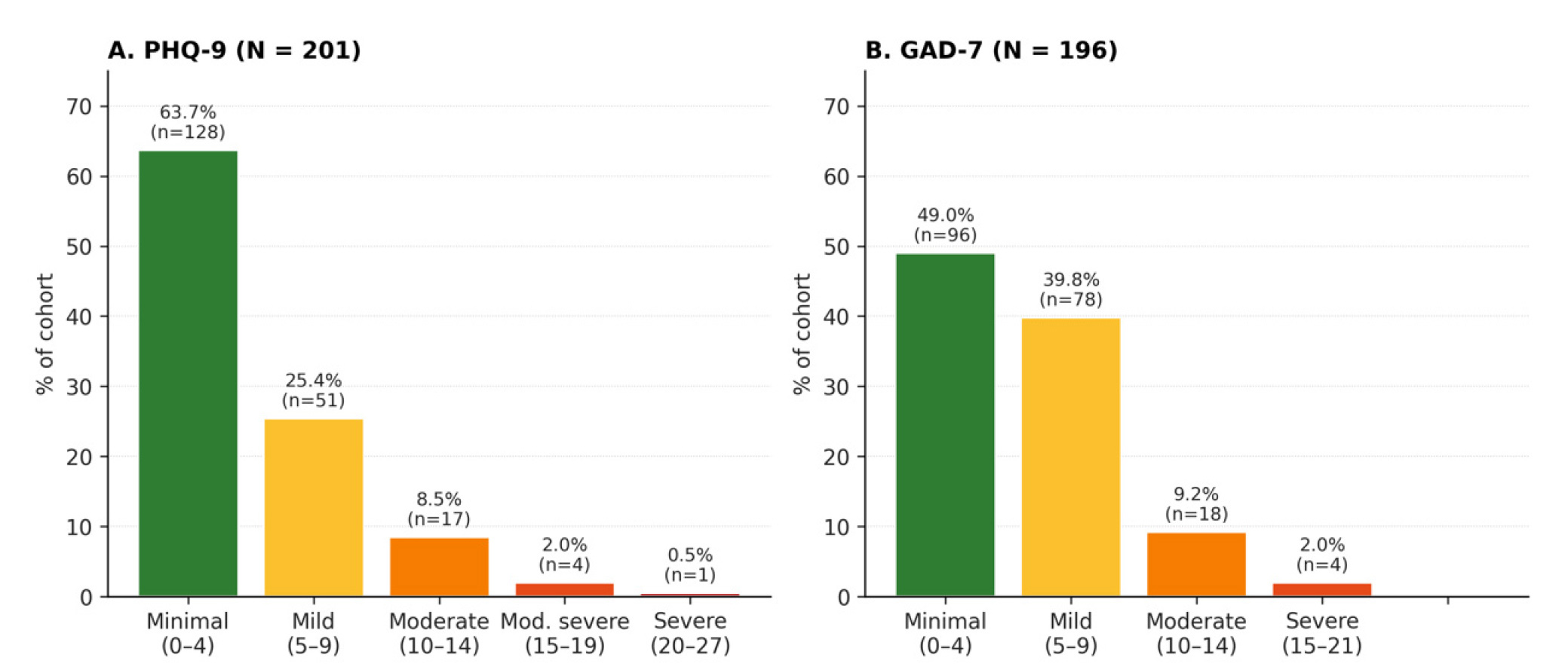
Figure 1.
Severity distribution of depressive (PHQ-9, panel A) and anxious (GAD-7, panel B) symptoms in the 2024 cohort
3.4Referral pathway adherence and clinical follow-up
All 12 participants flagged by a positive PHQ-9 item 9 were contacted within 72 hours by the on-call liaison psychiatrist through the opt-in channel; 9 (75.0%; 95% CI 42.8–94.5) completed an in-person evaluation at the Resident Mental Health service, 2 declined further follow-up but reported that the contact had been useful, and 1 was initially unreachable despite the full three-attempt protocol but self-presented later in the academic year. Considering all critical results—22 participants with PHQ-9 ≥ 10 and 22 with GAD-7 ≥ 10 (overlap of 14, yielding 30 distinct residents), plus 5 additional residents with a positive item 9 whose total scores remained below the ≥ 10 threshold—35 unique participants were eligible for proactive outreach, of whom 26 (74.3%; 95% CI 56.7–87.5) attended at least one appointment within the first month of the academic year. Given the small denominators, these proportions carry wide confidence intervals and should be read as an operational conversion rate of the referral pathway—the proportion of identified risk successfully routed to clinical evaluation—rather than as precise performance estimates. Every resident flagged for outreach received the full three-attempt contact protocol, and those who declined or deferred evaluation were kept in an open-access channel with a standing offer of re-contact. All 35 flagged residents remained active in their training program through the end of the first academic year, with no attrition in the high-risk group.
3.5Subgroup analyses
Women reported significantly higher GAD-7 scores than men (5.60 ± 3.59 vs. 4.51 ± 3.70;
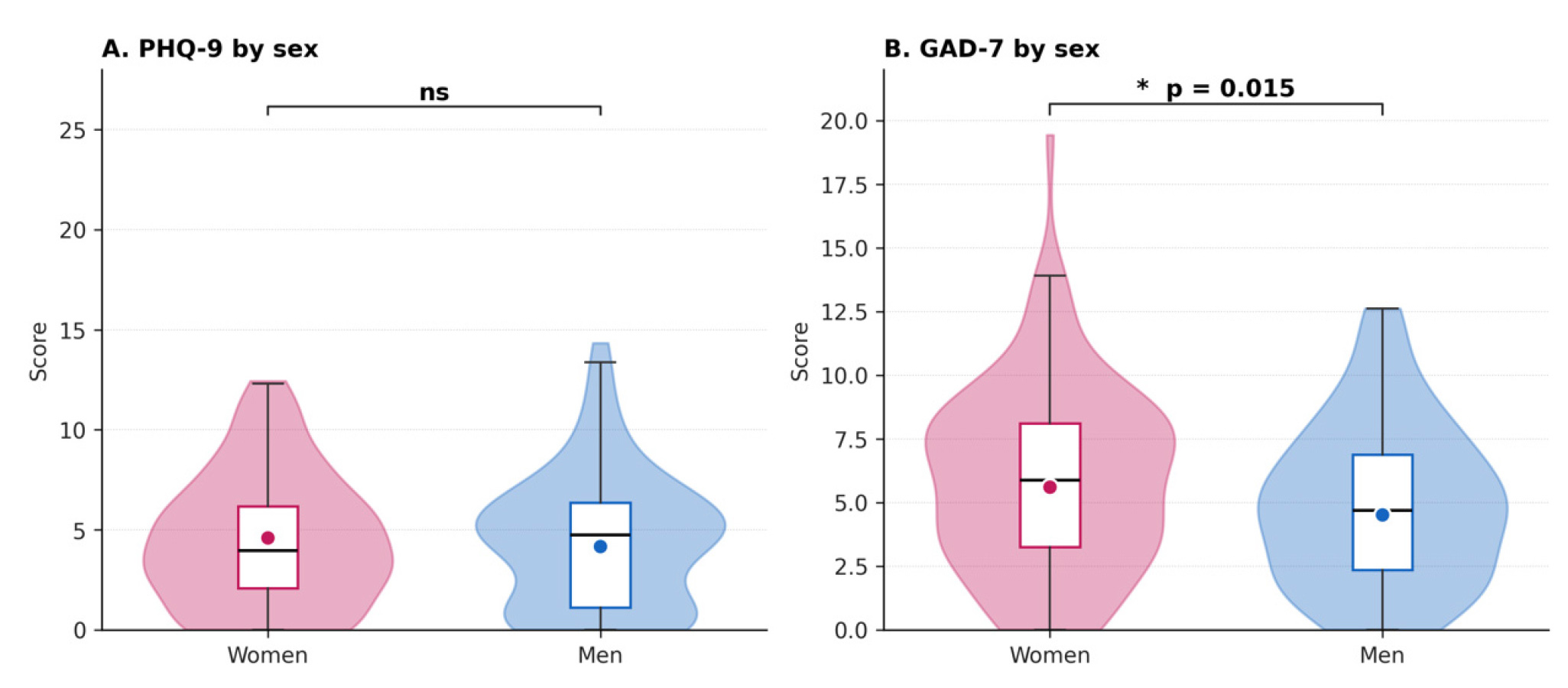
Figure 2.
Distribution of PHQ-9 (panel A) and GAD-7 (panel B) scores by sex
4.Discussion
We designed, implemented, and evaluated a 30-minute mental-health screening program embedded in the mandatory induction of a national high-specialty hospital, and assessed it across two consecutive cohorts. The program met its four operational objectives: universal screening proved feasible (93.9% participation), organizationally acceptable (92% rated it useful and 96% reported clearer knowledge of support pathways), and productive in yield (35 participants flagged for proactive outreach in a single cohort), and it demonstrated an effective referral pathway (three quarters of the highest-risk participants reached in-person evaluation). The high internal consistency of both instruments supports their use as repeatable workforce-monitoring tools across institutions.
The central finding for hospital administration is that clinically significant psychiatric morbidity is present and largely undetected in the incoming workforce at the precise moment it assumes clinical responsibility: roughly one in nine incoming residents met the threshold for a probable depressive or anxiety disorder, and one in seventeen reported thoughts of self-harm. Left undetected, this morbidity translates into measurable organizational costs—impaired performance, absenteeism, turnover, and elevated risk to patient safety.[4,5] The program converts a recurring, low-visibility institutional risk into an actionable, triaged workflow at negligible marginal cost.
4.1Implications for hospital management
Three recommendations follow for hospital administrators considering a comparable program. First, data governance is decisive. Reliable workforce mental-health data depend on the personnel’s trust that their responses cannot be used against them administratively; visibly anonymous digital collection—rather than merely stated confidentiality—materially increased participation between the 2023 and 2024 cohorts (from 88.6% to 93.9% on the PHQ-9) and mitigated the social-desirability bias that undermines punitive or identifiable screening. Second, the resource footprint is minimal: the program consumed 30 minutes of an existing mandatory agenda and the time of existing clinical staff, with no new facilities or licensing costs, indicating a favorable cost-to-benefit ratio for institutions that already maintain a psychiatry or occupational-health service. Third, the value of screening is realized only through the referral pathway; institutions without a downstream clinical resource should establish or contract one before implementation, because detection without a route to care creates institutional liability rather than mitigating it.
4.2Comparison with prior work
Prior institutional efforts to address resident well-being have concentrated on debriefing, peer support, and burnout workshops delivered after distress emerges. Our program differs in acting at the point of workforce entry and in coupling standardized screening to an automated, time-sensitive referral rule with measured adherence. The yield observed here is consistent with international prevalence estimates,[2,3] while the Mexican, public-sector setting addresses a gap in a literature dominated by studies that are dated or concentrated outside national high-specialty centers.[7,9]
4.3Limitations
This evaluation has seven principal limitations. First, the program depends on the existence of a downstream referral resource; institutions without one must identify an alternative pathway before implementation. Second, follow-up was measured indirectly through attendance at the Resident Mental Health service rather than through blinded clinical assessment. Third, the instruments and supporting materials are in Spanish and reference Mexican prevalence data; translation and cultural adaptation are required for other settings. Fourth, screening captures a single time point and does not assess symptom trajectory across the academic year. Because yield may vary from year to year with cohort composition and context, single-cohort estimates should be read as a baseline rather than a stable annual rate, and repeated administration is required to characterize year-on-year change. Fifth, the acceptability survey relied on immediate self-report, which may overestimate satisfaction. Sixth, a positive PHQ-9 item 9 identifies passive ideation or thoughts of self-harm and served here as a conservative safety trigger, not as a validated measure of suicide risk; confirmatory clinical assessment is required in every flagged case. Seventh, this evaluation focused on the feasibility, yield, and referral performance of the screening pathway and did not measure downstream occupational outcomes—such as absenteeism, missed clinical days, or reported error rates—so the program’s effect on these workforce indicators, and whether they change after the first year of implementation, remains to be established.
4.4Future directions
The program is being extended in four directions: repeated administration to successive annual cohorts to characterize year-on-year variation; 6- and 12-month follow-up screening to characterize longitudinal trajectory; expansion to two additional national centers to test transportability across institutions; and integration of the anonymous flag system with the institutional electronic health record to automate outreach, together with linkage of screening results to institutional occupational indicators such as absenteeism, sick leave, and reported clinical incidents to test whether early detection and referral translate into measurable workforce outcomes. Institutions adopting this model should anticipate 2–3 months of preparatory work to establish or strengthen the referral pathway before the first induction session.
5.Conclusions
Embedding systematic mental-health screening into mandatory residency induction is feasible, acceptable, and high-yield, and it can be operated at negligible marginal cost within an existing institutional structure. By identifying hidden psychiatric morbidity and routing at-risk personnel to rapid clinical evaluation, the program offers hospital administrators a scalable, replicable instrument for workforce risk management and occupational-health governance.
Authors contributions
EFEA and OML conceived and designed the program. EFEA, OML, MGOM, DNMS, CAHL, MFTG, and ASR implemented the program across the 2023 and 2024 cohorts. EFEA performed the data analysis with input from OML and DNMS. EFEA drafted the manuscript. All authors critically revised the manuscript for important intellectual content and approved the final version.
Funding
The authors received no external financial support for this work.
Conflicts of Interest Disclosure
The authors declare they have no conflicts of interest.
Informed consent
Written consent documentation was waived due to anonymous, low-risk routine screening.
Ethics approval
The Publication Ethics Committee of the Association for Health Sciences and Education. The journal’s policies adhere to the Core Practices established by the Committee on Publication Ethics (COPE).
Provenance and peer review
Not commissioned; externally double-blind peer reviewed.
Data availability statement
The datasets generated and/or analyzed during the current study are available from the corresponding author on reasonable request.
Data sharing statement
The study respondents did not give consent for their data to be shared publicly; therefore, the data are not available for sharing.
AI disclosure statement
Generative AI tools were used solely for English-language editing of the manuscript text. No content within the tables, figures, or data analysis was generated by AI tools. The authors retain full responsibility for the integrity and accuracy of all content.
Acknowledgements
None.
References
- Veasey S, Rosen R, Barzansky B. Sleep loss and fatigue in residency training: a reappraisal. JAMA. 2002;288(9):1116-1124. doi:10.1001/jama.288.9.1116
- Mata D, Ramos M, Bansal N. Prevalence of depression and depressive symptoms among resident physicians: a systematic review and meta-analysis. JAMA. 2015;314(22):2373-2383. doi:10.1001/jama.2015.15845
- Nkrumah S, Adu M, Agyapong B. Prevalence and correlates of depression, anxiety, and burnout among physicians and postgraduate medical trainees: a scoping review of recent literature. Front Public Health. 2025;13:1537108. doi:10.3389/fpubh.2025.1537108
- Shanafelt T, Dyrbye L, Sinsky C. Relationship between clerical burden and characteristics of the electronic environment with physician burnout and professional satisfaction. Mayo Clin Proc. 2016;91(7):836-848. doi:10.1016/j.mayocp.2016.05.007
- World Health Organization. Mental health at work: policy brief. Geneva; World Health Organization. 2022. https://www.who.int/publications/i/item/9789240053052
- Dyrbye L, Thomas M, Shanafelt T. Systematic review of depression, anxiety, and other indicators of psychological distress among U.S. and Canadian medical students. Acad Med. 2006;81(4):354-373. doi:10.1097/00001888-200604000-00009
- Dávila Valero J. Prevalence of anxiety disorders in resident physicians at IMSS High-Specialty Medical Units. Rev Med IMSS. 2006;44(3):213-220.
- Montiel-Jarquín A, Romero-Figueroa M, Irigoyen-Coria A. Prevalence of anxiety in orthopedic residents of the Mexican Institute of Social Security. Cir Cir. 2015;83(1):31-36.
- Mascarúa-Lara E, Ortiz-León S, Chávez-León E. Prevalence of depression and anxiety in resident physicians. Rev Med Inst Mex Seguro Soc. 2014;52:S70-S79.
- Vargas-Terrez B, Villamil-Salcedo V, Rodríguez-Estrada C. Suicide risk according to specialty and year of medical residency. Cir Cir. 2015;83(6):472-481.
- Borges G, Nock M, Haro Abad J. Twelve-month prevalence of and risk factors for suicide attempts in the World Health Organization World Mental Health Surveys. J Clin Psychiatry. 2010;71(12):1617-1628. doi:10.4088/JCP.08m04967blu
- Kroenke K, Spitzer R, Williams J. The PHQ-9: validity of a brief depression severity measure. J Gen Intern Med. 2001;16(9):606-613. doi:10.1046/j.1525-1497.2001.016009606.x
- Spitzer R, Kroenke K, Williams J. A brief measure for assessing generalized anxiety disorder: the GAD-7. Arch Intern Med. 2006;166(10):1092-1097. doi:10.1001/archinte.166.10.1092
- von Elm E, Altman D, Egger M. The Strengthening the Reporting of Observational Studies in Epidemiology (STROBE) statement: guidelines for reporting observational studies. Lancet. 2007;370(9596):1453-1457. doi:10.1016/S0140-6736(07)61602-X
 This work is licensed under a