1.Introduction
Hepatitis C virus (HCV) infection remains an important public health issue because persistent infection may progress to chronic hepatitis, cirrhosis, and hepatocellular carcinoma.[1] Since the introduction of direct-acting antiviral (DAA) therapy, treatment outcomes for HCV infection have improved dramatically, and highly effective antiviral treatment is now widely available.[2,3,4,5] Therefore, appropriate evaluation and referral of patients with positive HCV test results are essential.
Despite advances in treatment and nationwide efforts to promote hepatitis screening and access to care, some patients with positive anti-HCV test results do not undergo further evaluation by hepatology specialists. Tanaka et al. estimated that a substantial number of individuals with viral hepatitis remain unaware of their infection status in Japan.[6,7] In addition, positive anti-HCV test results are often identified during routine clinical practice, including preoperative screening and evaluations performed by non-hepatology departments. Consequently, positive results may not always lead to appropriate follow-up, specialist referral, or assessment for antiviral treatment.
Failure to follow up abnormal test results is a recognized patient safety concern. To reduce overlooked cases of viral hepatitis, several institutions have implemented alert systems linked to hepatitis virus test results and reported improvements in referral to hepatology specialists.[8,9,10,11] However, such systems are not universally available, and hospitals may need to rely on manual review processes and multidisciplinary collaboration to identify patients whose positive test results have not been appropriately addressed.
At our institution, an incident report revealed a patient whose positive anti-HCV antibody results had been documented repeatedly over several years without referral to the gastroenterology department. This event raised concerns regarding overlooked positive test results and prompted a hospital-wide review by the Department of Medical Safety Management. At the time of the incident, it was unclear how many patients with previously documented positive anti-HCV test results remained without appropriate specialist evaluation. Therefore, a comprehensive review of anti-HCV-positive patients recorded since the introduction of electronic medical records was undertaken to identify unresolved cases and assess the extent of this patient safety issue.
Although the intervention was implemented in 2020, failures in the follow-up of abnormal test results continue to be recognized as an important patient safety concern. Understanding the characteristics and outcomes of overlooked anti-HCV-positive cases may provide useful lessons for institutions seeking to improve systems for managing abnormal test results.
The purpose of this study was to identify overlooked positive anti-HCV test results and evaluate the impact of a hospital-wide medical safety intervention on physician response and specialist referral.
2.Methods
2.1Data collection
Patient information was obtained from the electronic medical record database CLISTA! version 3.5 (Medical Engineering Institute Inc., Mie, Japan).
2.2Identification of patients with overlooked positive anti-HCV test results
We conducted a hospital-wide review to identify patients with positive anti-HCV test results who had not undergone evaluation by the gastroenterology department after testing positive. The following data were collected: sex, age, department that initially ordered the anti-HCV test, and the patient’s primary outpatient department at the time of review.
Patients meeting all of the following criteria were included:
1. Positive anti-HCV antibody result recorded at our hospital between July 2010 and June 2020.
2. No consultation with the gastroenterology department after confirmation of anti-HCV positivity.
3. At least one outpatient visit to our hospital between July 2019 and June 2020.
4. Expected to continue follow-up at our hospital after July 2020.
Electronic medical records were introduced in 2006; therefore, data prior to this period were unavailable.
Patients were excluded if they:
1. Had transferred to another institution, died, or had discontinued follow-up before July 2020.
2. Had documented HCV treatment at another institution, were determined not to require further hepatology evaluation because of advanced illness or terminal disease, or were subsequently confirmed not to have clinically relevant HCV infection.
The study population was defined based on a hospital-wide medical safety review conducted in 2020 to identify patients with overlooked positive anti-HCV test results. Accordingly, the present study evaluated the outcomes of patients identified through this intervention.
2.3Medical safety intervention
After identification of eligible patients, the Department of Medical Safety Management notified the responsible outpatient physicians through the electronic medical record system.
The notification informed physicians that the patient had a documented positive anti-HCV antibody result and recommended confirmation of the patient’s hepatitis management status and consideration of referral to the gastroenterology department when appropriate.
In addition, department heads were informed of the review findings, and the issue of overlooked positive anti-HCV test results was shared at a hospital management meeting to promote institutional awareness.
2.4Outcome assessment
After the intervention, patient management status was reviewed through electronic medical records.
Outcomes were categorized into two groups: (1) patients referred to the gastroenterology department, and (2) patients managed by their original outpatient department.
For patients referred to the gastroenterology department, outcomes were classified as follows:
1. Follow-up evaluation without antiviral treatment
2. Initiation of DAA treatment
3. Refusal of further evaluation or treatment after specialist consultation
For patients managed by their original outpatient department, outcomes were classified as follows:
1. Previous HCV treatment history confirmed
2. Refusal of referral to the gastroenterology department
3. Transfer to another institution
4. No further hepatology evaluation considered necessary because of clinical condition
5. Self-initiated evaluation at another facility
The primary outcome was physician response to the notification. Secondary outcomes included referral to the gastroenterology department and initiation of DAA treatment.
2.5Ethics approval
This study was approved by the Ethics Committee of Ogaki Municipal Hospital (approval number: 20210624-8) and the Ethics Committee of Gifu Pharmaceutical University (approval number: 3-28). The study was conducted in accordance with the principles of the Declaration of Helsinki. Informed consent was obtained using an opt-out approach because of the retrospective nature of the study.
2.6Statistical analysis
Data were summarized descriptively. Continuous variables are presented as medians (range), and categorical variables are presented as numbers and percentages. Statistical analyses were performed using descriptive methods because the primary objective of the study was to evaluate the outcomes of a medical safety intervention.
3.Results
3.1Identification of patients with overlooked positive anti-HCV test results
A flowchart of patient selection is shown in Figure 1. Between July 2010 and June 2020, 9,300 patients with positive anti-HCV antibody test results visited our hospital. Of these, 4,623 patients had already consulted the gastroenterology department after confirmation of anti-HCV positivity. A further 4,403 patients had no hospital visits during the one-year period from July 2019 to June 2020.
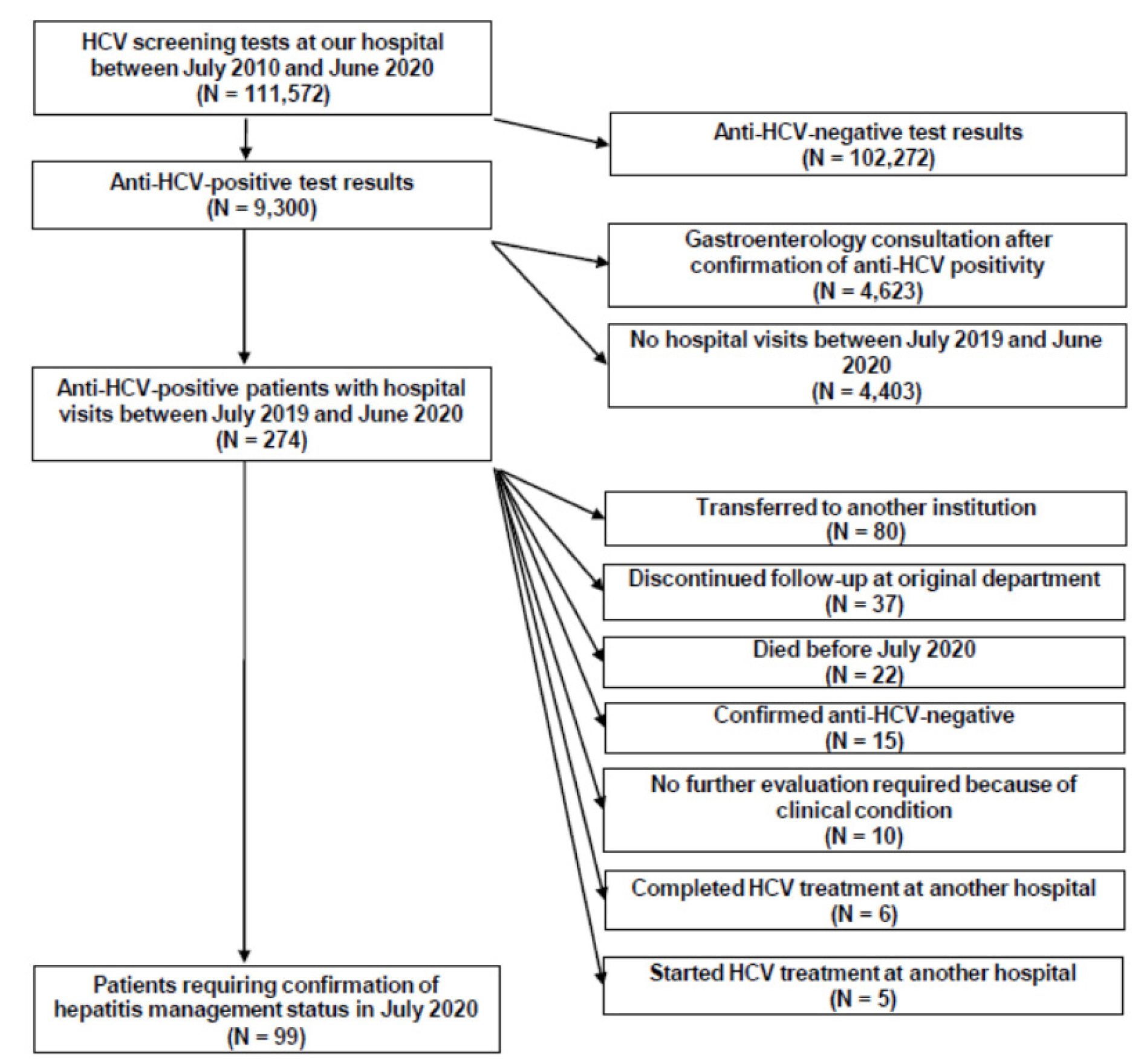
Figure 1.
Flowchart of patient selection
Among 274 anti-HCV-positive patients who continued follow-up at our institution during the study period, 99 patients met the criteria for review and required confirmation of hepatitis management status after exclusion of patients who had transferred to another institution, discontinued follow-up, or died.
Patient characteristics are summarized in Table 1. The median age was 75 years (range, 40–91 years), and 54 patients (54.5%) were male. The departments that most frequently ordered the initial anti-HCV antibody test were cardiology (16.2%), emergency medicine (10.1%), gastrointestinal surgery (6.1%), and ophthalmology (6.1%). At the time of review, cardiology (31.3%) and urology (10.1%) were the most common primary outpatient departments (see Table 2).
| Sex | |
| Male | 54 |
| Female | 45 |
| Age (years) | 75 (40–91) |
| < 65 | 18 |
| 65–74 | 33 |
| 75–84 | 36 |
| ≥ 85 | 12 |
| Cardiology | 16 (16.2) | 31 (31.3) |
| Emergency Medicine | 10 (10.1) | 0 (0.0) |
| Gastrointestinal Surgery | 6 (6.1) | 5 (5.1) |
| Ophthalmology | 6 (6.1) | 3 (3.0) |
| Orthopaedics | 5 (5.1) | 6 (6.1) |
| Respiratory Medicine | 5 (5.1) | 6 (6.1) |
| Urology | 5 (5.1) | 10 (10.1) |
| Neurology | 2 (2.0) | 3 (3.0) |
| Haematology | 2 (2.0) | 4 (4.0) |
| Respiratory Surgery | 2 (2.0) | 2 (2.0) |
| Plastic Surgery | 2 (2.0) | 0 (0.0) |
| Diabetes and Nephrology | 1 (1.0) | 9 (9.1) |
| Dermatology | 1 (1.0) | 8 (8.1) |
| Obstetrics and Gynaecology | 1 (1.0) | 4 (4.0) |
| Otolaryngology | 1 (1.0) | 0 (0.0) |
| Cardiovascular Surgery | 1 (1.0) | 3 (3.0) |
| Health Management Center | 1 (1.0) | 1 (1.0) |
| Neurosurgery | 0 (0.0) | 4 (4.0) |
| Unknown |
32 (32.3) | 0 (0.0) |
| Total | 99 | 99 |
3.2Physician response following the medical safety intervention
Following notification by the Department of Medical Safety Management, 86 of 99 patients (86.9%) had documented physician responses regarding their anti-HCV-positive status. No documented response was identified in 13 patients (13.1%) (see Table 3).
| Referral to gastroenterology department | Specialist evaluation without antiviral treatment | 45 (45.5) |
| Initiation of DAA treatment | 7 (7.1) | |
| Refused further evaluation or treatment after specialist consultation | 3 (3.0) | |
| Management by primary outpatient department | Previous HCV treatment history confirmed | 16 (16.2) |
| Refused referral to gastroenterology department | 8 (8.1) | |
| Referred to another institution | 3 (3.0) | |
| No further hepatology evaluation considered necessary because of clinical condition | 3 (3.0) | |
| Independent evaluation at another facility | 1 (1.0) | |
| No documented physician response | — | 13 (13.1) |
3.3Management outcomes after physician notification
A cascade of physician response, specialist referral, and DAA treatment initiation is shown in Figure 2. Of the 99 patients requiring confirmation of hepatitis management status, physician responses were documented in 86 patients (86.9%). Subsequently, 55 patients (55.6%) were referred to the gastroenterology department, and seven patients (7.1%) ultimately initiated DAA therapy.

Figure 2.
Cascade of physician response, specialist referral, and DAA treatment initiation following identification of overlooked anti-HCV-positive test results
Among the 55 patients referred to the gastroenterology department, 45 (45.5%) underwent specialist assessment without antiviral treatment, seven (7.1%) initiated DAA therapy, and three (3.0%) declined further evaluation or treatment after specialist consultation.
Among patients managed by their original outpatient departments, 16 (16.2%) had a previously confirmed history of HCV treatment and therefore did not require referral. Eight patients (8.1%) declined referral to the gastroenterology department, three (3.0%) were transferred to another institution, three (3.0%) were judged not to require further evaluation because of their clinical condition, and one patient (1.0%) underwent independent evaluation at another facility.
The median age of patients who initiated DAA therapy was 70 years (range, 44–84 years) (see Table 4).
| 1 | Female | 44 | Dec 2019 | Ophthalmology | Dec 2020 | May 2021 |
| 2 | Female | 50 | Jun 1996 | Obstetrics and Gynaecology | Dec 2020 | Apr 2021 |
| 3 | Female | 63 | Dec 2012 | Orthopaedics | Sep 2020 | Mar 2021 |
| 4 | Female | 70 | Mar 2012 | Plastic Surgery | Oct 2020 | Feb 2021 |
| 5 | Female | 73 | Jun 2016 | Gastrointestinal Surgery | Jan 2021 | Mar 2021 |
| 6 | Female | 81 | Dec 2018 | Emergency Medicine | Oct 2020 | Feb 2021 |
| 7 | Female | 84 | Jan 2011 | Cardiology | Sep 2020 | Oct 2020 |
4.Dicussion
In this single-center quality improvement study, a hospital-wide review conducted by the Department of Medical Safety Management identified 99 patients with positive anti-HCV antibody results who had not undergone gastroenterology evaluation and required confirmation of hepatitis management status. Following physician notification, documented responses were obtained for 86.9% of patients, and 55.6% were referred to the gastroenterology department. These findings suggest that a structured medical safety intervention can facilitate reassessment of overlooked positive test results and improve linkage to specialist evaluation. Although the intervention was implemented in 2020, the findings remain relevant because failures in the follow-up of abnormal test results continue to represent an important patient safety concern across healthcare systems. Unlike previous studies that evaluated automated electronic alert systems, the present study demonstrates the feasibility of a manual medical safety-led review and physician notification strategy for identifying overlooked positive anti-HCV test results. This approach may provide a practical alternative for hospitals where automated alert systems are unavailable or difficult to implement because of financial or technical constraints.
HCV infection remains an important public health issue because persistent infection may progress to chronic hepatitis, cirrhosis, and hepatocellular carcinoma.[1] Since the introduction of DAA therapy, highly effective and well-tolerated treatment has become widely available.[2,3,4] Therefore, failure to appropriately follow up positive anti-HCV test results may represent a missed opportunity for potentially curative treatment. Despite nationwide efforts to improve hepatitis screening and access to care, previous reports have suggested that a substantial number of individuals remain unaware of their viral hepatitis status in Japan.[5] Our findings indicate that, even within a single institution, positive anti-HCV test results may remain clinically unresolved for prolonged periods.
The present study was prompted by an incident report involving a patient whose anti-HCV-positive status had been documented repeatedly without referral to the gastroenterology department. This case illustrates an important patient safety issue: abnormal test results may be recorded in the medical record but fail to trigger appropriate follow-up actions. Positive anti-HCV results are frequently identified during preoperative screening, emergency care, or routine evaluations performed by departments outside hepatology. Consequently, responsibility for subsequent evaluation may become unclear, particularly when patients continue long-term follow-up in a different department. The distribution of departments observed in this study supports this concern, as anti-HCV testing was frequently ordered in cardiology, emergency medicine, gastrointestinal surgery, and ophthalmology, whereas many patients were subsequently managed in other outpatient departments.
A major finding of this study was that physician notification prompted documented clinical action in most patients. Among the 99 patients requiring confirmation of hepatitis management status, 86 had documented physician responses and 55 were referred to the gastroenterology department. Figure 2 demonstrated progressive attrition from physician notification to specialist referral and ultimately to DAA initiation. Previous studies have demonstrated the usefulness of alert systems linked to hepatitis virus test results in promoting referral to hepatology specialists.[8,9,10,11] Our findings support these observations and suggest that systematic review processes may improve follow-up of positive hepatitis screening results even in institutions without fully automated alert systems.
Although DAA treatment was initiated in only seven patients, treatment initiation was not the primary objective of this intervention. Rather, the aim was to identify patients whose positive anti-HCV test results had not been appropriately addressed and to prompt responsible physicians to confirm management status. From this perspective, the intervention was successful because it led to reassessment in the majority of identified patients. Importantly, several patients who subsequently initiated DAA therapy had positive anti-HCV results documented many years before specialist referral. In one patient, more than two decades elapsed between the first documented anti-HCV-positive result and gastroenterology consultation. These findings suggest that positive screening results may remain unresolved for prolonged periods despite being recorded in the electronic medical record. Collectively, these findings indicate that the principal challenge was not the availability of effective treatment, but the failure to ensure appropriate follow-up of abnormal test results. The relatively low rate of DAA initiation reflected the clinical characteristics of the identified population rather than failure of the intervention itself. Many patients had previously completed HCV treatment, declined specialist referral, or were not considered appropriate candidates for antiviral therapy because of advanced comorbidities or limited life expectancy. Therefore, physician reassessment and appropriate clinical decision-making should also be regarded as successful outcomes of this medical safety intervention, regardless of whether antiviral treatment was ultimately initiated.
Several patients who initiated DAA treatment were elderly, including individuals in their 80s. Previous studies have shown that DAA therapy is generally safe and effective even in older patients.[12,13] Furthermore, antiviral treatment may remain cost-effective in appropriately selected elderly patients.[14] Therefore, advanced age alone should not preclude consideration of specialist evaluation when positive anti-HCV results are identified.
Patient refusal and incomplete follow-up remained important barriers. Eight patients declined referral to the gastroenterology department, and 13 patients had no documented physician response following notification. These findings indicate that identification of overlooked positive test results alone is insufficient. Effective linkage to care requires not only physician awareness but also patient education, communication, and systems to confirm completion of recommended follow-up. In addition, some patients had advanced comorbidities or limited life expectancy, highlighting the importance of individualized clinical decision-making.
This study has several limitations. First, it was conducted at a single institution, which may limit the generalizability of the findings. Second, the study focused on positive anti-HCV antibody results rather than HCV-RNA results. Therefore, we did not evaluate the full HCV cascade of care, including active infection, antiviral treatment eligibility, treatment completion, or sustained virologic response. However, the purpose of this study was not to evaluate HCV treatment outcomes but to examine a medical safety intervention designed to identify and address overlooked positive screening results. Third, because the interval between the initial positive anti-HCV result and the intervention varied substantially, some patients had already transferred to another institution, discontinued follow-up, or died before review. This limitation reflects the challenges of retrospective identification and supports the need for earlier notification systems. Fourth, the intervention evaluated in this study was conducted in 2020, and patients identified after this period were not included. Therefore, the findings should be interpreted as an evaluation of a specific hospital-wide medical safety intervention rather than a contemporary estimate of overlooked anti-HCV-positive patients. Nevertheless, the findings remain relevant because failures in the follow-up of abnormal test results continue to occur in routine clinical practice. Finally, reasons for refusal of referral or treatment were not systematically collected, and no formal cost-effectiveness analysis was performed.
5.Conclusions
A hospital-wide medical safety review identified patients with overlooked positive anti-HCV antibody results and prompted physician response and specialist referral in most cases. These findings demonstrate that unresolved positive test results may persist across departments and over extended periods of time. Rather than evaluating treatment effectiveness, this study demonstrates that a structured medical safety review can improve the process of identifying overlooked positive anti-HCV test results and promoting appropriate specialist referral. Medical safety-led review and physician notification may represent a practical strategy for improving follow-up of abnormal test results, particularly in institutions without automated alert systems.
Authors contributions
Concept and design: Megumi Nakashima, Hideki Hayashi, Eiseki Usami. Data acquisition: Megumi Nakashima, Michio Kimura. Data analysis and interpretation: Megumi Nakashima, Seiki Kiriyama, Hidenori Toyoda, Shuji Yamashita, Eiseki Usami. Manuscript drafting: Megumi Nakashima, Eiseki Usami. Critical revision of the manuscript: Michio Kimura, Seiki Kiriyama, Hidenori Toyoda, Shuji Yamashita, Hideki Hayashi, Eiseki Usami. Supervision: Eiseki Usami. All authors reviewed and approved the final manuscript and agreed to be accountable for all aspects of the work.
Funding
The authors received no financial support for the research, authorship, and/or publication of this article.
Conflicts of Interest Disclosure
The authors declare they have no conflicts of interest.
Informed consent
This study was conducted as a retrospective analysis, and the requirement for written informed consent was waived by the institutional review board. Participation opportunities were provided through an opt-out process.
Ethics approval
The Publication Ethics Committee of the Association for Health Sciences and Education. The journal’s policies adhere to the Core Practices established by the Committee on Publication Ethics (COPE).
Provenance and peer review
Not commissioned; externally double-blind peer reviewed.
Data availability statement
The data that support the findings of this study are available from the corresponding author upon reasonable request.
Data sharing statement
The study respondents did not give consent for their data to be shared publicly, therefore, the data are not available for sharing.
Acknowledgements
None.
References
- Kiyosawa K, Sodeyama T, Tanaka E. Interrelationship of blood transfusion, non-A, non-B hepatitis and hepatocellular carcinoma: analysis by detection of antibody to hepatitis C virus. Hepatology. 1990;12(4 Pt 1):671-675. doi:10.1002/hep.1840120409
- Chayama K, Suzuki F, Karino Y. Efficacy and safety of glecaprevir/pibrentasvir in Japanese patients with chronic genotype 1 hepatitis C virus infection with and without cirrhosis. J Gastroenterol. 2018;53(4):557-565. doi:10.1007/s00535-017-1391-5
- Toyoda H, Chayama K, Suzuki F. Efficacy and safety of glecaprevir/pibrentasvir in Japanese patients with chronic genotype 2 hepatitis C virus infection. Hepatology. 2018;67(2):505-513. doi:10.1002/hep.29510
- Toyoda H, Atsukawa M, Watanabe T. Real-world experience of 12-week direct-acting antiviral regimen of glecaprevir and pibrentasvir in patients with chronic hepatitis C virus infection. J Gastroenterol Hepatol. 2020;35(5):855-861. doi:10.1111/jgh.14874
- Bhattacharya D, Aronsohn A, Price J. Hepatitis C Guidance 2023 Update: AASLD-IDSA Recommendations for Testing, Managing, and Treating Hepatitis C Virus Infection. Clin Infect Dis. 2023:ciad319.
- Tanaka J, Koyama T, Mizui M. Total numbers of undiagnosed carriers of hepatitis C and B viruses in Japan estimated by age- and area-specific prevalence on the national scale. Intervirology. 2011;54(4):185-195. doi:10.1159/000324525
- Ko K, Akita T, Satake M. Epidemiology of viral hepatitis C: road to elimination in Japan. Glob Health Med. 2021;3(5):262-269. doi:10.35772/ghm.2021.01069
- Inaba T, Matsumoto K, Shimizu Y. Usefulness of the alert message for patients with positive anti-hepatitis C virus antibody test in a university hospital. J Kyoto Pref Univ Med. 2020;129:341-347.
- Uchida-Kobayashi S, Enomoto M, Fujii H. Promotion of intra-hospital referral of hepatitis B and C virus carriers to hepatology specialists by an electronic medical record-based alert system: a case study at a university hospital. Kanzo. 2016;57(1):7-16. doi:10.2957/kanzo.57.7
- Cunningham E, Wheeler A, Hajarizadeh B. Interventions to enhance testing, linkage to care, and treatment initiation for hepatitis C virus infection: a systematic review and meta-analysis. Lancet Gastroenterol Hepatol. 2022;7(5):426-445. doi:10.1016/S2468-1253(21)00471-4
- Choi J, Park J, Choi W. Improving the hepatitis C virus care cascade with the in-hospital Reflex tEsting ALarm-C (REAL-C) model. Liver Int. 2024;44(5):1243-1252. doi:10.1111/liv.15877
- Pugliese N, Giorgini A, Maggi D. Directly acting antivirals are safe and effective in HCV-positive patients aged 80 years and older: a multicenter real-life study. Expert Opin Drug Saf. 2021;20(7):839-843. doi:10.1080/14740338.2021.1921144
- De Santis A, Maggi D, Lubrano Lobianco F. Safety and efficacy of directly-acting antiviral therapy for chronic hepatitis C virus in elderly people. Aging Med. 2021;4(4):304-316. doi:10.1002/agm2.12190
- Kaishima T, Akita T, Ohisa M. Cost-effectiveness analyses of anti-hepatitis C virus treatments using quality-of-life scoring among patients with chronic liver disease in Hiroshima Prefecture, Japan. Hepatol Res. 2018;48(7):509-520. doi:10.1111/hepr.13053
 This work is licensed under a