1.Introduction
In the spring of 2011, the Centers for Medicare and Medicaid Services (CMS), under the Affordable Care Act, announced creation of the Hospital Value-Based Purchasing (HVBP) program. This initiative reflected the emerging practice of “pay for performance,” that is, paying hospitals based on the quality, not just quantity, of care delivered.[1] The HVBP was soon followed, in 2014, by the Hospital-Acquired Condition Reduction Program (HACRP). The programs are similar in that they focus on hospital-acquired conditions and use financial incentives (either rewards or penalties) to achieve improvements. In the case of the HVBP, a hospital is rewarded for meeting quality-performance standards by receiving back a portion of funds (2%) initially withheld to fund the program.[2] In the case of HACRP, a hospital incurs a 1% reduction in its aggregate Medicare payment if the hospital’s performance score falls within the lowest quartile of all hospitals subject to the program.[3,4,5] With some exceptions, all general acute-care hospitals are subject to both valued-based purchasing (VBP) programs.[2,3]
Almost all prior studies assessing the impact of these programs have looked at either the HVBP or HACRP, in isolation, despite early calls to consider their interaction, given their similarities and overlapping timing.[5] Most of these studies have used either interrupted time series (ITS)[6,7,8,9] or difference-in-difference (DID) models[9,10] as empirical strategies to identify effects. Researchers employing DID models face the difficulty of finding appropriate control groups. For example, hospitals excluded from the policies tend to be critical care,[10] children’s, or psychiatric hospitals, all different from the treated hospitals in terms of market and patient population. Sheetz and colleagues conducted a study on the HACRP (the second program), employing an alternative DID strategy, using outcomes not targeted by the program (i.e., non-targeted outcomes) as the control group with data from the Michigan Surgical Quality Collaborative, a voluntary network of statewide hospitals focused on quality improvement and sharing best practices.[9] They mapped outcomes to several of the patient safety indicators (PSIs) from the Agency for Healthcare Research and Quality (AHRQ) as well as other events specifically targeted by the Michigan collaborative (e.g., catheter associated urinary tract infection (CAUTI), surgical site infection (SSI) for colectomy and hysterectomy, and Clostridium difficile infection). They compared these outcomes to several non-targeted outcomes, finding no evidence the HACRP was associated with an independent decrease in the targeted conditions.
The use of ITS has similarly found minimal effects from these programs. In the one previous study of which the current authors are aware that examines both the HVBP and HACRP, Hsu and colleagues found no statistically significant effect from the implementation of either program on four types of hospital-acquired infections, including CAUTI, SSI, as well as central line-associated bloodstream infection (or CLABSI).[6]
Blending the work of Sheetz et al. and Hsu et al., this study looks at the impact of both programs, employing a modified interrupted time-series design on a panel of all Florida general acute-care hospitals subject to both programs, between 2007 and 2019. It analyzes effects on three nurse-sensitive PSI outcomes, two targeted by the programs (PSIs #7 and #8) and one non-targeted outcome (PSI #4). The present study also uniquely explores mechanisms by which hospitals have achieved quality improvement by examining the relationship between these nurse-sensitive outcomes and two nursing-based measures representing investment in quality: expenditure on the continuing education and training of nurse staff, and a measure of per patient staffing.[11,12,13] While recent studies have found beneficial effects from investment in education and training,[14,15] there is more mixed evidence from earlier studies on per-patient staffing.[11,13,16,17,18] Further evidence on specific types of quality investment can guide hospital administrators, and policy makers, on whether, and where, to invest in quality.
Analytically, regression coefficients on the quality investments will be subject to bias due to non-random selection or omitted variables. While there is no formal method to address these issues when they involve more than one covariate (in this case, multiple measures of investment), this study minimizes the impact in two ways. First, it exploits the panel structure of the data to control for unobserved and time-invariant hospital-level factors (i.e., fixed effects) that could be correlated with both the investments and the PSI outcomes. Second, the present study constructs a proxy-variable framework by including several hospital-level groups of covariates to control for unobserved determinants of patient safety. Each group of proxy variables represents a broad and largely intangible domain of the hospital, or its environment, that is unobserved or simply unmeasurable, but that likely influences nursing-based investments as well as nurse-sensitive quality outcomes (i.e., PSI).[14] As described in the next section, the proxy-variable framework is a standard statistical method, using observable measures to represent unobserved (or unmeasurable) but relevant covariates in regression analyses (see, for example, DeSimone[19]).
The hospital-domain framework developed here draws from the health policy literature on hospital context.[20,21,22] Given the uneven success of early quality improvement initiatives, researchers and health care practitioners began to focus on the importance of the specific internal and external characteristics of hospitals as key to the implementation and success of any particular initiative.[20] In terms of patient safety, organizational characteristics (e.g., financial status, complexity, academic affiliation, service mix), leadership, and market competition were identified as contextually relevant factors determining the successful cultivation of patient safety skills and practices.[20,22,23,24] The present study incorporates four such contextual elements, or domains: organizational type, organizational structure, leadership, and market conditions.[14] Each domain is represented by a set of proxy measures, which are the control variables in the empirical model developed here.
2.Methods
2.1Empirical model
As mentioned, this study employs a modified interrupted time-series empirical model to assess the impact of the VBP programs on three of AHRQ’s PSIs: PSI #7 (CLABSI), PSI #8 (patient falls with hip fracture), and PSI #4 (failure to rescue, FTR). All three are well established in the literature as nurse-sensitive outcomes.[13,25,26,27,28,29,30] However, while PSI #7 is one of several directly targeted hospital-acquired infections in both the HVBP and HACRP, and PSI #8 is indirectly targeted in both programs as a component of PSI-90 (a composite measure representing 10 individual PSIs and directly targeted by both programs[5,31,32]), PSI #4 is a target of neither program. Identification of program effects is therefore established through the variation in targeting across these three clinically related (i.e., nursing) outcomes.
For each PSI rate, “
To address non-random selection and omitted-variable bias associated with the nursing-based investments, each unobservable domain, contained in , is theoretically defined as a linear function of its observable proxies, , and an error term, (see Equation 2):
If each set of proxies (
2.2Hypotheses
The coefficients of interest in (3) are those that capture the effects of the VBP programs. They include and , representing the change in trends (i.e., slopes) of the PSI rates following the announcement of each VBP program, and , , , and , capturing the change in the effect of the nursing-based investments following the announcement of each program. We predict, unambiguously, a negative sign on the trend coefficients (, < 0), given the expected incentives of the VBP programs to reduce PSI rates. The prediction for the investment coefficients is, however, ambiguous. Investment in quality should lead to a reduction in adverse patient safety events. However, investment could also lead to “surveillance bias,” that is, more detection and an increase in observed rates.[17,36]
Our prediction for all investment coefficients (including the baseline coefficients, and ) is, therefore, ambiguous (, , , , , is less than or greater than 0).
2.3Data and measures
Data for this study come from the annual 2007 to 2019 hospital inpatient discharge and financial files from Florida’s Agency for Health Care Administration (AHCA).[37] The discharge files include patient demographic characteristics, payer (i.e., insurance), diagnoses, and procedures performed during each hospital stay. The financial files provide extensive information on hospital revenues, expenses, staff, types of services, and ownership status. The discharge data is combined with AHRQ’s PSI software to calculate annual hospital-level PSI rates for PSI #7 (CLABSI), PSI #8 (patient falls with hip fracture), and PSI #4 (FTR). Two versions of the software are used to account for the 2016 (specifically, fourth quarter of 2015) conversion from ICD-9 to ICD-10 diagnoses codes.[38,39] ICD-10 codes have expanded the coding of diagnoses (from 5 to 7 digits), allowing for more specificity and flexibility in capturing risk and severity of illness relative to the ICD-9 version.[40,41] While the AHRQ software provides for continuity between the two coding systems, we nonetheless construct a dummy variable, setting it equal to 1 after 2015, to account for any changes in the administrative coding of these measures.
The financial data are used to create the measures of nursing-based investment, which specifically come from two cost centers defined uniformly across all Florida hospitals.[42] The first center, Nursing Administration, is responsible for the management of nursing staff (e.g., scheduling, supervision, and evaluation), including any continuing education provided the staff. The center’s non-wage portion of expenditures is used as the measure of continuing education (Education). The second cost center, Acute Medical/Surgical Services, is responsible for all acute care provided by the hospital. The number of full-time equivalent (FTE) personnel in this center is used to construct a measure of per-patient staffing. Because AHCA does not separately identify nursing personnel (not since 2009), the present study uses the number of all FTE non-physician medical and surgical staff per thousand inpatient days for the measure of staffing (Staffing). This broader measure includes nursing as well as all other non-physician staff involved in delivering acute-care services.[42]
The AHCA financial data are also used to create a set of proxy variables for each of the four hospital domains: organizational type, organizational structure, leadership, and market conditions. These measures, chosen to address potential selection or omitted-variable bias, encompass various dimensions of the hospital that directly or indirectly influence safety culture, including teaching and safety-net status, types of services, use of information technology, resources dedicated to assessing quality, and market competition.[14,20,43] Definitions of these measures are presented in Appendix A1, with a crosswalk to their respective domains and underlying contextual factors. It is important to note that Kaplan et al., in conducting a systematic review of 47 articles on quality improvement, specifically identified Medicare and Medicaid (which are used here as proxies for financial status due to their relatively low reimbursement) as contextual factors in three articles.[20] In addition, while the leadership domain is represented by a sole financial measure, expenditure on quality review of medical care, that measure contains the portion of all physician remuneration (fees, salaries, benefits) that goes toward that activity.[42] It reasonably represents, therefore, the “physician involvement” contextual factor.
Hospitals subject to the HVBP and HACRP are identified using publicly available performance reports for each program from the CMS.[44,45] In establishing the expected breaks in the data for each program (that is, the point in time marking the beginning of the post-policy period for each program), timing is based on when each program was announced rather than formally implemented. Indeed, anticipatory changes in response to health policy announcements (prior to implementation) have been observed in a wide variety of cases, such as changes in sugar-sweetened beverage consumption, birth timing, prescription drug use, and vaping.[46,47,48,49] Thus, following Sheetz et al. and Arntson et al., the present study uses linear splines to capture change in trends following the announcement of each program.[9,50] Because the HVBP program was announced relatively early in 2011 (April),[51] 2011 is used as the starting point for that program. For the HACRP, because it was announced in the latter part of 2013 (August),[9] the following year, 2014, is used as its starting point.
3.Results
3.1Descriptive statistics by policy period
From an initial sample of 159 general acute-care hospitals subject to both VBP programs, twenty-two hospitals were removed because of missing variables or lack of patient discharges at risk of any of the three patient safety events. Hospitals excluded from the sample are smaller on average, in terms of revenues, beds, and inpatient volume, but otherwise do not differ meaningfully from the included hospitals (see Appendix A2). The final sample consisted of a balanced panel of 137 hospitals (
Table 1 presents descriptive statistics of the three PSI outcomes and nursing-based investments in each of the three policy periods of this study: baseline (or the pre-VBP period), HVBP (the years after announcement of the HVBP program), and HACRP (the years after announcement of the HACRP). The last two sets of columns present difference in means between consecutive periods. To achieve sufficient statistical power, PSI rates #7 (CLABSI) and #8 (patient falls with hip fracture) are measured for every 1,000 inpatients, while the rate for PSI #4 (FTR), because it represents five post-surgical conditions (pneumonia, pulmonary embolism/deep vein thrombosis, sepsis, shock/cardiac arrest, and gastrointestinal hemorrhage/acute ulcer) is left unadjusted.
| PSI #7 Rate (CLABSI) | Rate of CLABSI per 1,000 inpatients | 0.798 | 0.836 | 0.373 | 0.425 | 0.152 | 0.205 | −53.3% | .000 | −59.3% | .000 |
| PSI #8 Rate (Patient Falls) | Rate of in-hospital fall with hip fracture (Falls) per 1,000 inpatients | 0.115 | 0.158 | 0.085 | 0.130 | 0.081 | 0.123 | −26.4% | .002 | −4.0% | .658 |
| PSI #4 Rate (FTR) | Rate of death among surgical inpatients (FTR) | 0.120 | 0.058 | 0.121 | 0.057 | 0.127 | 0.063 | 1.2% | .710 | 4.5% | .136 |
| Nursing Administration Expenditure (Education) | Total non-wage expenditure on administration of hospital’s nursing staff, including continuing education programs (000s of 2019 dollars) | $722 | $1,177 | $828 | $1,873 | $1,337 | $3,173 | 14.7% | .283 | 61.5% | .003 |
| FTE Non-Physician Per-Patient Staffing (Staffing) | Number of FTE non-physician medical-surgical personnel per 1,000 inpatient days | 2.84 | 1.31 | 3.03 | 1.39 | 3.17 | 1.51 | 6.7% | .030 | 4.4% | .130 |
Among these three rates (outcomes), PSI #7 (CLABSI) experiences the most consistent and dramatic reduction over the three policy periods. Between the baseline and HVBP period, the mean rate of PSI #7 falls by 53.3%, from 0.798 to 0.373 per 1,000 inpatients (
In contrast, PSI #8 (patient falls) is only indirectly targeted, through the composite measure, PSI-90. That may partly explain why it falls by only 26.4% between baseline and HVBP, from 0.115 to 0.085 per 1,000 inpatients (
For the two measures of nursing-based investments, non-wage nursing administration expenditure (converted to 2019 dollars), which includes expenditure on staff education and training, increases by only 14.7% (insignificantly) between baseline and HVBP, but leaps by 61.5% (
3.2Key regression results
Table 2 presents key results of the modified interrupted time-series (ITS) regressions for the three PSI outcomes. For each outcome, there are three sets of results. The first set is the “announcement” (Main) model presented in Section 2.1, which reflects hospitals responding to each program at the point it was announced. These results are presented in panels A1, B, and C of Table 2. The second set of results, presented in panels A2 and D, is for the “implementation” (Implement) model, which assumes hospitals responded as each program was implemented (that is, when CMS began levying financial penalties or rewards). The third set of results (panels A1, B, and C) is for an alternative to the main model that controls for nonlinear trends in the baseline period (note: baseline trends are not presented in the table). All coefficients are interpreted as percentage changes in PSI rates (see footnote b. of Table 2).
| A1. Pre-Announcement of HVBP (2007-2010) | |||||||||
| Education | .042 |
N/A | .045 |
−.006 | N/A | −.006 | −.005 |
N/A | −.005 |
| Staffing | .021 | N/A | .012 | .002 | N/A | .0001 | −.003 | N/A | −.002 |
| A2. Pre-Implementation of HVBP and HACRP (2007-2014) | |||||||||
| Education | N/A | .0004 | N/A | N/A | −.008 |
N/A | N/A | −.002 | N/A |
| Staffing | N/A | .018 | N/A | N/A | .002 | N/A | N/A | −.004 | N/A |
| Post-HVBP Trend | −.162 |
N/A | −.136 |
−.017 |
N/A | −.009 |
−.0003 | N/A | −.0008 |
| Education x HVBP Dummy | −.063 |
N/A | −.068 |
−.002 | N/A | −.0015 | .006 |
N/A | .005 |
| Staffing x HVBP Dummy | −.043 |
N/A | −.045 |
−.006 | N/A | −.004 | −.002 | N/A | −.003 |
| Post-HACRP Trend | .116 |
N/A | .119 |
.010 |
N/A | .009 |
−.006 |
N/A | −.005 |
| Education x HACRP Dummy | −.005 | N/A | −.006 | .013 |
N/A | .012 |
.003 | N/A | .003 |
| Staffing x HACRP Dummy | .070 |
N/A | .075 |
.009 |
N/A | .008 |
.002 | N/A | .003 |
| Post-Implementation Trend | N/A | .039 |
N/A | N/A | .001 | N/A | N/A | −.006 |
N/A |
| Education x Implement Dummy | N/A | −.014 | N/A | N/A | .010 |
N/A | N/A | .003 | N/A |
| Staffing x Implement Dummy | N/A | .024 |
N/A | N/A | .001 | N/A | N/A | .002 | N/A |
| Within R2 | .367 | .315 | .439 | .033 | .029 | .039 | .019 | .019 | .020 |
For the main model, Panel A1 shows that, in the baseline period, a standard deviation increase in expenditure on nursing-staff education (education) is associated with a 4% (0.042) increase in the rate of PSI #7 (CLABSI). However, this effect is reversed in the post-announcement period of HVBP (Panel B), where the rate of CLABSI decreases by 6.3% (–0.063) as education increases. Panel B also shows a statistically significant 16% decrease in trend for CLABSI (–0.162) as well as a 4% (–0.043) decrease that is associated with nurse staffing (staffing). These latter two effects change sign, however, in the post-announcement period of HACRP (Panel C), where there is an attenuating effect on trend (0.116) as well as a reversal of the effect of staffing from the previous period (0.070). For PSI #8 (patient falls), there is a statistically significant 2% (–0.017) decrease in trend in the post-HVBP period (Panel B) that attenuates in the post-HACRP period (Panel C: 0.010). Increases in education and staffing are also associated with approximately 1% increases in patient falls in the post-HACRP period (Panel C: Education: 0.013; Staffing: 0.009). For the non-targeted outcome, PSI #4 (FTR), there are small (approximately 0.5%) offsetting effects associated with education between the baseline and post-HVBP periods (Panel A1: –0.005; Panel B: 0.006), as well as a small decrease in trend in the post-HACRP period (Panel C: –0.006).
For the implementation (Implement) model, presented in panels A2 and D, there is only one post-policy period since the HVBP and HACRP programs were implemented at the same time in October of 2014.[31,53] For PSI #7 (CLABSI), there is a statistically significant increase in trend (0.039), as well as an increase associated with staffing (0.024), following implementation (Panel D). For PSI #8 (patient falls), there are offsetting effects associated with education between the baseline and post-implementation periods (Panel A2: –0.008; Panel D: 0.010), and for PSI #4 (FTR), a statistically significant decrease in trend following implementation (Panel D: –0.006).
Interestingly, this latter effect, for the non-targeted outcome, is the only one with a negative sign on the coefficient. In general, the “implementation” specification of the model produces results that are consistent with the attenuation (that is, positive) effects obtained in the post-HACRP period of the main (announcement) model—which might be expected since the post-implementation and post-HACRP periods almost perfectly overlap. Nonetheless, the implementation model does not produce results consistent with the hypothesis of a negative (i.e., beneficial) effect of the VBP programs on trends, particularly for the targeted outcomes.
As shown in Figure 1, which presents the fitted values from the three regressions relative to the observed (actual) 95% confidence intervals for each of the PSI rates (in natural logs), there is a generally good fit of the regressions with the observed rates in each of the post-policy (i.e., after 2010 and 2013) periods. However, in the baseline period for both targeted outcomes (PSI #7 and PSI #8), the continuous upward movement of the fitted values masks a sharp upward spike in each before announcement of the HVBP program in 2011. Therefore, an alternative specification of the main model was estimated that allows for nonlinear trends in the baseline period. The results of this regression are presented in the third column for each outcome in Table 2.
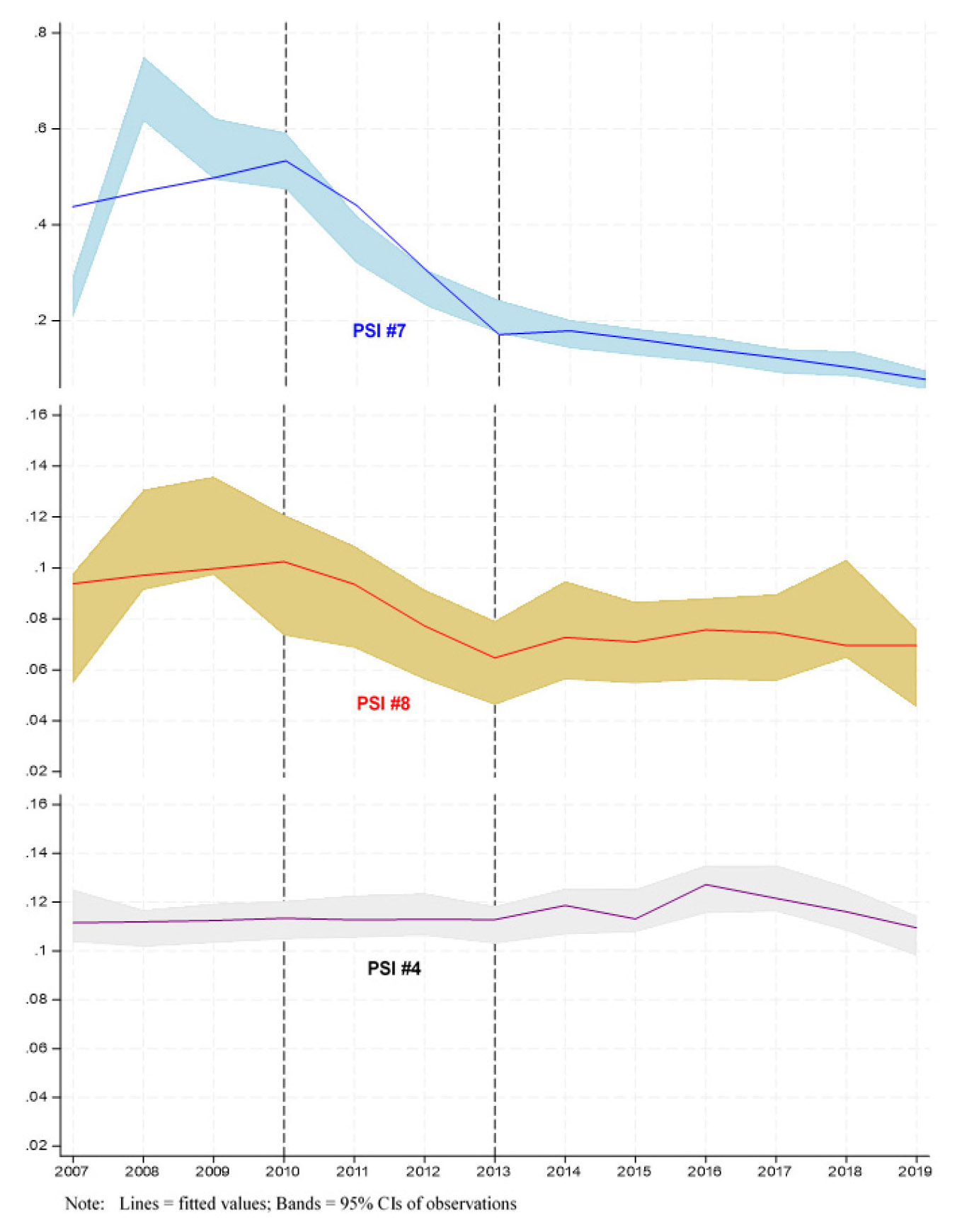
Figure 1.
Fitted and observed PSI rates (natural logs)
In comparing coefficients and statistical significance in the first and third columns for each outcome (panels A1, B, and C), there are no substantive differences for the two targeted outcomes (PSIs #7 and #8) except for moderately smaller coefficients on trend in the post-HVBP period (Panel B: PSI #7: –0.136 vs. –0.162; PSI #8: –0.009 vs. –0.017). In contrast, there are no statistically significant coefficients in the nonlinear model for the non-targeted outcome, PSI #4. Because the nonlinear model represents a better fit of the data, it is applied in the analyses presented in the next two sections and there is no further consideration of the non-targeted outcome, PSI #4 (see Appendix A3 for complete results of the nonlinear model).
3.3Sensitivity to omitted variables
As mentioned, coefficients for the quality investments may be subject to bias due to non-random selection or omitted variables. Recent work by Oster, and by Diegert, Masten and Poirier (DMP), have extended the theoretical literature on the robustness of regression coefficients in the face of omitted variables.[34,35] Following Oster’s work, the present study calculated the coefficient of proportionality, or “delta,” a measure of non-random selection on unobservable relative to observable control variables. Under a generally recommended theoretical assumption of
The results of these analyses are presented in Table 3, with the first column showing the estimated values of delta, from Oster (2019), for each of the statistically significant quality-investment coefficients in regressions for PSI #7 and #8. All values are well above the key threshold of one (1), indicating insensitivity to omitted variables.
| PSI #7 (CLABSI) | |||
| Education | 8.8 | 0.284 | 11 |
| Education × HVBP Dummy | 9.2 | 0.275 | 11 |
| Staffing × HVBP Dummy | 3.4 | 0.331 | 9 |
| Staffing × HACRP Dummy | 4.0 | 0.704 | 12 |
| PSI #8 (Patient Falls) | |||
| Education × HACRP Dummy | 8.6 | 0.149 | 9 |
| Staffing × HACRP Dummy | 14.3 | 0.266 | 8 |
From DMP (2026), the second column of Table 3 shows the estimated value of the breakdown point (“rxbar”) for each statistically significant quality-investment covariate, with the third column indicating the number of calibration parameters falling below that value (see Appendix A4 for the calibration estimates obtained from first stage regressions of each quality-investment covariate). In each case, a good majority (> 8) fall below the breakdown point, a further indication of insensitivity to omitted variables.
In addition, based on recent work by Masten and Poirier, Oster’s delta was evaluated for a sign change in the covariate’s coefficient (as opposed to no effect). In this test, delta has an upper bound of one (1) for robustness against a sign change,[54] which was obtained for four of the six covariates. In the regression for PSI #7, values of 0.93 and 0.94 were obtained for baseline and post-HVBP education, respectively (not shown). Thus, while the remaining four covariates are deemed robust against statistical insignificance and a sign change in the face of omitted variables, the latter two are deemed robust against only statistical insignificance.
3.4Evidence of confounding factors
This section investigates the potential influence of three confounding factors on the main results: surveillance bias, the rapid transition from inpatient to outpatient care during the period of this study, and a concurrent quality-improvement initiative: the Florida Hospital Engagement Network (HEN). As stated earlier, our hypotheses about the quality investments are ambiguous because of the possibility of “surveillance bias,” that is, more investment in quality may only lead to more detection (positive coefficients) rather than reduction (negative coefficients) of hospital-acquired conditions. Indeed, in the main results, all statistically significant quality-investment coefficients in the post-HACRP period have positive signs (see Panel C, Table 2). Two distinguishing features of the post-HACRP period are high levels of education spending and low rates of CLABSI (PSI #7) relative to the baseline period (see Table 1). Therefore, to investigate evidence of surveillance bias, two sub-samples of hospitals were created, one with “high” average education spending and the other with “low” average CLABSI rates, in the baseline period. “High” was defined as average expenditure of at least $1 million (in 2019 dollars) on nursing-staff education, and “low” as a CLABSI (PSI #7) rate of no more than 0.27 per 1,000 inpatients in the baseline period. These respective figures fall almost exactly between the mean values between the post-HVBP and post-HACRP periods of the full sample (see Table 1). They also provided sufficient observations to run viable regressions of the nonlinear main model against each sub-sample. Key results of these regressions are presented as the first two sets of results in Table 4 (under the header, “Surveillance Bias”) for PSIs #7 and #8, respectively, where evidence of potential surveillance bias is supported by positive coefficients on the investment variables.
| Education | .007 | .231 |
.095 | .025 | .0004 | .089 | −.001 | −.009 |
| Staffing | .163 |
−.044 | .091 | .017 | .027 | −.039 |
.031 | .001 |
| Post-HVBP Trend | −.123 |
.002 | −.164 |
−.139 |
−.002 | −.005 | −.019 |
−.012 |
| Education × HVBP Dummy | −.009 | −.375 |
−.337 |
−.037 | −.009 | −.271 |
−.044 | .003 |
| Staffing × HVBP Dummy | −.113 |
.043 |
−.125 |
−.049 |
−.005 | .026 | −.009 | −.007 |
| Post-HACRP Trend | .095 |
−.013 | .153 |
.124 |
.002 | .010 | .022 | .014 |
| Education × HACRP Dummy | .012 | .094 | .217 | −.001 | .007 |
.160 | .066 | .015 |
| Staffing × HACRP Dummy | .038 | −.036 | .121 |
.072 |
−.008 | .011 | .014 | .009 |
| Within R2: | 0.615 | 0.163 | 0.679 | 0.431 | 0.166 | 0.175 | 0.085 | 0.042 |
For PSI #7 (CLABSI), there is a statistically significant positive coefficient associated with staffing in the baseline period (0.163) of the “High Baseline Ed. Spending” sample (Panel A), that is only partially offset in the post-HVBP period (Panel B: –0.113), with no further effects (from quality investments) in the post-HACRP period (Panel C). Thus, overall, there is a positive relationship between staffing and CLABSI in hospitals with high levels of expenditure on education. In the “Low Baseline PSI #7” sample, there is a statistically significant positive coefficient associated with education in the baseline period (Panel A: 0.231) that is effectively reversed in the post-HACRP period (Panel B: –0.375). However, the statistically significant positive coefficient associated with staffing in the post-HVBP period (Panel B: 0.043) is not changed in the post-HACRP period, also indicating, in hospitals with low levels of PSI #7 (CLABSI), a positive overall relationship between staffing and CLABSI.
For PSI #8 (patient falls), there is a statistically significant positive coefficient on education (0.007) in the post-HACRP period (Panel C) of the “High Baseline Ed. Spending” sample, which is consistent with the corresponding result of the main model. In the “Low Baseline PSI #7” sample, there is a statistically significant negative coefficient associated with staffing in the baseline period (Panel A: –0.039), and a statistically significant negative coefficient associated with education in the post-HVBP period (Panel B: –0.271). These results suggest no surveillance bias, and indeed, that hospitals with high quality on one measure (e.g., PSI #7) are likely to make effective investments that improve quality in a related measure (e.g., PSI #8).
While there is no evidence to support surveillance bias for PSI #8, it is important to consider the transition from inpatient to outpatient procedures during the time of this study. In this sample of Florida hospitals, the outpatient rate (measured by percent of outpatient to total hospital revenue) rose by 9% between the post-HVBP and post-HACRP period, and by 18%, on average, between the baseline and post-HACRP period, consistent with national trends.[55] We hypothesize, therefore, that as hospitals increased outpatient care, resources for nurse staffing and education shifted from the inpatient to outpatient setting while at the same time there was a decrease (holding other things constant) in the population of post-surgical inpatients at risk of a fall. This would be consistent with positive coefficients for trends and the quality-investment measures in the post-HACRP period of the main model. To assess this hypothesis, the main model was run against another sub-sample that included only hospitals maintaining no more than the baseline average outpatient rate (0.37) for the entire study period, effectively removing hospitals that significantly increased outpatient services at any point during the study period. Results for each outcome are presented in the “Outpatient Growth” columns of Table 4.
Results for PSI #7 (CLABSI) are consistent with the main model. This is not surprising, since CLABSI is associated with an injection or use of a vascular device (e.g., a catheter) during a multi-day hospital stay,[56] and therefore unlikely to occur in an outpatient setting. On the other hand, for PSI #8 (patient falls), results in Table 4 are notably different from the main model. While there is still a statistically significant negative coefficient on post-HVBP trend (Panel B: –0.019), all post-HACRP covariates—trend and both quality-investment measures—become statistically insignificant in the “Outpatient Growth” regression (Panel C), which suggests results in the main model for PSI #8, in the post-HACRP period, may be partly driven by the increase in outpatient care.
The last set of results for each outcome in Table 4 assesses the impact of the HEN. In 2011, CMS initiated the Partnership for Patients program, which provided funding for the creation of HENs, a voluntary group of hospitals that share technical support and best practices to improve quality (similar to the Michigan Surgical Quality Collaborative of the Sheetz et al.’ study).[57] Approximately 75 Florida hospitals voluntarily participated in a statewide HEN between 2012 and 2015.[58] In order to determine if the HEN program might have driven some of the main results, hospitals participating in the program were excluded from the analytic sample. As shown in Table 4, For PSI #7, education in the baseline and post-HVBP period are not statistically significant, in contrast to the corresponding results of the main regression. For PSI #8, the coefficient on baseline education is statistically significant in the HEN regression, in contrast to being statistically insignificant in the main regression, and in the post-HACRP period, staffing goes from statistical significance in the main regression, to statistical insignificance in the HEN regression. Thus, while inclusion of the HEN hospitals in the main model affects the statistical significance of some investment measures, it does not change the arithmetic signs of their coefficients, nor does it have any effect on the statistical significance and direction of post-announcement trends.
Overall, the evidence from these four secondary regressions suggests that, in the main regression, surveillance bias is a confounding influence on PSI #7 (CLABSI), and the increase in outpatient care is a confounding influence on PSI #8 (patient falls). Nonetheless, consistent throughout the four secondary regressions, and aligned with the main results, is a negative (i.e., beneficial) association of PSI outcomes with trends and investments in the post-HVBP period, and a positive (i.e., attenuating) association of PSI outcomes with trends and investments in the post-HACRP period.
4.Discussion
This study ties closely with two previous studies that incorporated an interrupted time-series design to analyze the effect of VBP programs on rates of hospital-acquired conditions, including CLABSI.[6,9] Unlike both of those studies, which found no evidence of effects on targeted outcomes, this study finds evidence of negative (i.e., beneficial) effects on the two targeted outcomes analyzed (CLABSI and patient falls). Like Sheetz et al.,[9] the present study analyzed state-level hospital data, setting break (or post-policy) points at the time of announcement rather than formal implementation. However, while Sheetz and colleagues looked at only the second of the two VBP programs, the HACRP, this study assessed both the HVBP program and the HACRP, finding that it was only the first program, HVBP, that was associated with statistically significant and beneficial effects. Hsu et al. did look at both programs.[6] However, they looked for post-implementation effects, finding, as found here, a lack of improvement under that assumption.
While it should not be surprising to discover hospitals were motivated to make changes as soon as the VBP programs were announced, it is striking, given their similar aims and targeted outcomes, so little research (beyond Hsu and colleagues) has analyzed the impact of these programs in tandem. Moreover, from review of the literature, more attention has focused on the quality-improving impact of the second program, the HACRP,[9,12,59] which this study suggests may have been a redundant and non-effective follow-up to the HVBP program. Coming less than three years after announcement of the HVBP program, the HACRP most likely did little to change what hospitals were already doing to improve quality. If anything, the findings presented here suggest the HACRP was disruptive to improvement, in that attenuating effects are observed for trends following its announcement.
Results for the nursing-based investments are consistent with these findings. In the main regression results, increases in education and staffing are associated with 6.8% and 4.5% decreases, respectively, in rates of CLABSI in the post-HVBP period, while in the post-HACRP period, increases in both forms of investment are associated with increased rates of CLABSI. As hypothesized, and prior research supports, intensifying effort to reduce the incidence of this particular hospital-acquired condition can actually lead to increased detection and more recorded occurrences (“surveillance bias”).[17] Indeed, the secondary analysis conducted here suggests surveillance bias for CLABSI is associated with increased staffing in hospitals that are either already investing heavily in education or achieving high levels of quality (i.e., low rates of PSI #7). It is important to note that in their respective studies, Hsu et al. found increased rates of CLABSI in the post-implementation period of the VBP programs (HVBP and HACRP implemented together), while Sheetz et al. found targeted outcomes (including CLABSI) falling at lower rates than non-targeted outcomes in the post-announcement period of HACRP.[6,9] Neither study examined investment in quality nor the impact of surveillance bias. There is need to better understand—and account for—this potential distortion of quality reporting.
It is also important to point out that not all prior research has found the HACRP to be ineffective. Arntson et al., for instance, found a statistically significant decrease in the number (i.e., count) of PSI per discharge following the announcement of the HACRP.[50] Their study is not directly comparable to the present study because it involved a wider range of outcomes and was conducted at the patient (discharge) rather than institutional level. In any case, it is also important to make the distinction between the quality improvement impact of the HACRP (and the HVBP, for that matter) and the incentives it creates to invest in quality. Wood et al., for instance, found that between 2013 and 2020, 98% of hospitals in the worst-performing, penalized group (below the 25th percentile) in the early year of the HACRP (2013) had reduced rates of hospital-acquired infections in the later year (2020), compared to only 38.8 of hospitals in the non-penalized group.[60] While only indirect evidence of the program’s incentivizing impact, it is consistent with the general positive trends in education and staffing observed for the hospitals covered over the same time period in this study.
Limitations
This study has several limitations. First, the measures of hospital-acquired conditions, a subset of the AHRQ’s PSIs, come from administrative hospital data that tend to underreport the true incidence of these adverse events.[9,61] Thus, findings may understate the effect of the VBP programs and quality investments. Similarly, the measures of quality investment are based on standardized, and broad, measures from the data source (AHCA) and therefore include nursing activities unrelated to how they are conceptually defined as drivers of quality and safety. Consequently, estimated coefficients for these measures represent lower bound estimates due to imprecise measurement and corresponding attenuation bias. In addition, while effort was made to account for the most significant confounders that could distort the results, we cannot claim it was exhaustive and therefore cannot attribute causality to the VBP programs. Finally, this study is based on a sample of hospitals from a single state, so may not generalize to all U.S. hospitals, nor to other measures or types of hospital quality.
5.Conclusions
Addressing gaps in previous research, this study provides new insight on the impact of the CMS value-based purchasing (VBP) initiative for hospital-acquired conditions, introduced in 2011 and represented by the separate HVBP and HACRP programs. Employing a modified interrupted time-series empirical model and measuring the “announcement’ effect of each program against a select set of nurse-sensitive patient safety outcomes, including a directly targeted (CLABSI), indirectly targeted (patient falls), and non-targeted (FTR) outcome, this study finds evidence the VBP initiative was associated with improvement among Florida general hospitals in the first few years of its existence. Specifically, the study finds beneficial changes in trends, but with only the first-announced program, the HVBP, with similar evidence from increased investments in quality. These findings present, therefore, two policy implications for the VBP programs going forward.
First, while there have been calls for CMS to change the structure of the financial penalties of these programs to better incentivize quality improvement,[9,59,62,63] the findings presented here suggest an additional, if not alternative, recommendation: consolidation. Concerns about the overlap and interaction of these two VBP programs were first raised at inception.[5] Over a decade later, there is now evidence that may support these concerns, including the necessity of two programs that largely duplicate one another and may, together, be less than the sum of their parts. CMS has already taken steps to minimize duplication. As of 2019, the HVBP program does not include the composite PSI-90 (for which PSI #8 is a component), although it is still retained in the HACRP.[31,53] While CMS should continue eliminating duplication, which tends to penalize (or reward) hospitals multiple times for the same performance results, consolidating the programs might be a more effective and efficient solution.
Second, CMS should consider separately recognizing investment in quality. This study uniquely assesses the impact of the VBP programs on nursing-based investments in education and staffing, and while it finds evidence indicating the HVBP program (2011-2013) incentivized investment that led to reduced patient safety rates, that improvement may have created a situation—post-HACRP (2014-2019)—in which further investment only increased detection of outcomes that were already at, or near, maximum reduction. To better align hospital incentives with the goals of the VBP programs, CMS might want to consider developing validated measures of quality investment that would facilitate rewarding hospitals for maintaining high levels of quality.
Authors contributions
L.D.: Literature review, editing the article, and revising for critical analytical content; final approval of the version to be published. R.B.S.: Conception, design, and analyzing data; drafting the article; final approval of the version to be published.
Funding
None.
Conflicts of Interest Disclosure
The authors declare they have no conflicts of interest.
Informed consent
Obtained.
Ethics approval
The Publication Ethics Committee of the Association for Health Sciences and Education. The journal’s policies adhere to the Core Practices established by the Committee on Publication Ethics (COPE).
Provenance and peer review
Not commissioned; externally double-blind peer reviewed.
Data availability statement
This study was derived from a limited dataset supplied by the Florida Agency for Health Care Administration (AHCA), Florida Center for Health Information and Transparency, Office of Data Dissemination and Transparency (Tallahassee, FL). AHCA disclaims responsibility for any analysis, interpretations, or conclusions that were created from the authors’ use of the limited dataset.
Data sharing statement
The data were obtained under a Data Use Agreement (DUA) and cannot be shared due to the restrictions of that agreement.
Acknowledgements
None.
References
- Centers for Medicare & Medicaid Services (CMS). CMS issues final rule for first year of Hospital Value-Based Purchasing Program. Jan 30, 2026. https://www.cms.gov/newsroom/fact-sheets/cms-issues-final-rule-first-year-hospital-value-based-purchasing-program
- Centers for Medicare & Medicaid Services (CMS). The Hospital Value-Based Purchasing (VBP) Program. Jan 30, 2026. https://www.cms.gov/medicare/quality/value-based-programs/hospital-purchasing
- Centers for Medicare & Medicaid Services (CMS). Hospital-Acquired Condition Reduction Program. Jan 30, 2026. https://www.cms.gov/medicare/quality/value-based-programs/hospital-acquired-conditions
- Torrey T. Medicare and its Hospital Acquired Condition (HAC) Policy: There’s more to ’never events’ than patient safety. Verywell Health. June 18, 2024. https://www.verywellhealth.com/what-is-medicares-never-events-policy-2615384
- Kahn C 3rd, Ault T, Potetz L. Assessing Medicare’s hospital pay-for-performance programs and whether they are achieving their goals. Health Aff (Millwood). 2015;34(8):1281-8. doi:10.1377/hlthaff.2015.0158
- Hsu H, Wang R, Broadwell C. Association between federal value-based incentive programs and health care-associated infection rates in safety-net and non-safety-net hospitals. JAMA Netw Open. 2020;3(7):e209700. doi:10.1001/jamanetworkopen.2020.9700
- Waters T, Daniels M, Bazzoli G. Effect of Medicare’s nonpayment for hospital-acquired conditions: lessons for future policy. JAMA Intern Med. 2015;175(3):347-54. doi:10.1001/jamainternmed.2014.5486
- Vaz L, Kleinman K, Kawai A. Impact of Medicare’s hospital-acquired condition policy on infections in safety net and non-safety net hospitals. Infect Control Hosp Epidemiol. 2015;36(6):649-55. doi:10.1017/ice.2015.38
- Sheetz K, Dimick J, Englesbe M. Hospital-Acquired Condition Reduction Program is not associated with additional patient safety improvement. Health Aff (Millwood). 2019;38(11):1858-1865. doi:10.1377/hlthaff.2018.05504
- Ryan A, Burgess J Jr., Pesko M. The early effects of Medicare’s mandatory hospital pay-for-performance program. Health Serv Res. 2015;50(1):81-97. doi:10.1111/1475-6773.12206
- Unruh L, Zhang N. Nurse staffing and patient safety in hospitals: new variable and longitudinal approaches. Nurs Res. 2012;61(1):3-12. doi:10.1097/NNR.0b013e3182358968
- Hamadi H, Borkar S, Moody L. Hospital-Acquired Conditions Reduction Program, patient safety, and magnet designation in the United States. J Patient Saf. 2021;17(8):e1814-e1820. doi:10.1097/PTS.0000000000000628
- Needleman J, Buerhaus P, Mattke S. Nurse-staffing levels and the quality of care in hospitals. N Engl J Med. 2002;346(22):1715-22. doi:10.1056/NEJMsa012247
- Dynan L, Smith R. Sources of nurse-sensitive inpatient safety improvement. Health Serv Res. 2022;57(6):1235-1246. doi:10.1111/1475-6773.13979
- Duncan A, Leyk R, Mannuru D. A comprehensive approach to reducing patient safety indicators (PSI-90). J Patient Saf. 2025;21(4):e24-e28. doi:10.1097/PTS.0000000000001312
- Cook A, Gaynor M, Stephens M Jr. The effect of a hospital nurse staffing mandate on patient health outcomes: evidence from California’s minimum staffing regulation. J Health Econ. Mar 2012;31(2):340-8. doi:10.1016/j.jhealeco.2012.01.005
- Mark B, Harless D, Spetz J. California’s minimum nurse staffing legislation: results from a natural experiment. Health Serv Res. 2013;48(2 Pt 1):435-54. doi:10.1111/j.1475-6773.2012.01465.x
- Spetz J, Harless D, Herrera C. Using minimum nurse staffing regulations to measure the relationship between nursing and hospital quality of care. Med Care Res Rev. 2013;70(4):380-99. doi:10.1177/1077558713475715
- DeSimone J. Fraternity membership and binge drinking. J Health Econ. 2007;26(5):950-67. doi:10.1016/j.jhealeco.2007.01.003
- Kaplan H, Brady P, Dritz M. The influence of context on quality improvement success in health care: a systematic review of the literature. Milbank Q. 2010;88(4):500-59. doi:10.1111/j.1468-0009.2010.00611.x
- Kaplan H, Provost L, Froehle C. The Model for Understanding Success in Quality (MUSIQ): building a theory of context in healthcare quality improvement. BMJ Qual Saf. 2012;21(1):13-20. doi:10.1136/bmjqs-2011-000010
- Taylor S, Dy S, Foy R. What context features might be important determinants of the effectiveness of patient safety practice interventions?. BMJ Quality and Safety. 2011;20:611-617. doi:10.1136/bmjqs.2010.049379
- Shekelle P, Pronovost P, Wachter R. The top patient safety strategies that can be encouraged for adoption now. Ann Intern Med. 2013;158(5 Pt 2):365-8. doi:10.7326/0003-4819-158-5-201303051-00001
- Bates D, Singh H. Two decades since To Err Is Human: An assessment of progress and emerging priorities In patient safety. Health Aff (Millwood). 2018;37(11):1736-1743. doi:10.1377/hlthaff.2018.0738
- Thornlow D. Increased risk for patient safety incidents in hospitalized older adults. Medsurg Nurs. 2009;18(5):287-91.
- Heslop L, Lu S, Xu X. Nursing-sensitive indicators: a concept analysis. J Adv Nurs. 2014;70(11):2469-82. doi:10.1111/jan.12503
- Chau J, Lo S, Choi K. A longitudinal examination of the association between nurse staffing levels, the practice environment and nurse-sensitive patient outcomes in hospitals. BMC Health Serv Res. 2015;15:538. doi:10.1186/s12913-015-1198-0
- Audet L, Bourgault P, Rochefort C. Associations between nurse education and experience and the risk of mortality and adverse events in acute care hospitals: A systematic review of observational studies. Int J Nurs Stud. 2018;80:128-146. doi:10.1016/j.ijnurstu.2018.01.007
- Afaneh T, Abu-Moghli F, Mihdawi M. Identifying nursing-sensitive indicators for hospitals: A modified delphi approach. Cureus. 2024;16(5):e59472. doi:10.7759/cureus.59472
- Oner B, Zengul F, Oner N. Nursing-sensitive indicators for nursing care: A systematic review (1997-2017). Nurs Open. 2021;8(3):1005-1022. doi:10.1002/nop2.654
- Centers for Medicare & Medicaid Services (CMS). Hospital Value Based Purchasing (VBP) Program previous measures. Jan 30, 2026. https://qualitynet.cms.gov/inpatient/hvbp/measures#tab2
- National Quality Forum (NQF). Patient safety 2015 final technical report. 2016.
- Wooldridge J. Econometric Analysis of Cross Section and Panel Data. The MIT Press. 2010.
- Oster E. Unobservable selection and coefficient stability: Theory and evidence. Journal of Business and Economic Statistics. 2019;37(2):187-204. doi:10.1080/07350015.2016.1227711
- Diegert P, Masten M, Poirier A. Assessing omitted variable bias when the controls are endogenous. 2026. arXiv: 2504.21106v2
- Rajaram R, Barnard C, Bilimoria K. Concerns about using the patient safety indicator-90 composite in pay-for-performance programs. JAMA. 2015;313(9):897-8. doi:10.1001/jama.2015.52
- Agency for Health Care Administration (AHCA). Hospital inpatient discharge data (2010-2019) and hospital financial data (2010-2019). 2022. https://ahca.myflorida.com
- Agency for Healthcare Research and Quality (AHRQ). AHRQ QI software for SAS ICD-09-CM/PCS version 6.0.2, ICD-09. Month Day, Year. https://qualityindicators.ahrq.gov/archive/software?category=sas
- Agency for Healthcare Research and Quality (AHRQ). Patient safety indicator software version SAS v2019.0.1, ICD-10-CM/PCS. Month Day, Year. https://qualityindicators.ahrq.gov/archive/software?category=sas
- American Medical Association (AMA). The Differences Between ICD-9 and ICD-10. Jul 31, 2026. https://www.ama-assn.org/sites/ama-assn.org/files/corp/media-browser/premium/washington/icd10-icd9-differences-fact-sheet_0.pdf
- Johns Hopkins Health Plans (JHHP). Understanding ICD-10. Jul 31, 2026. https://www.hopkinsmedicine.org/johns-hopkins-health-plans/providers-physicians/icd-10
- Agency for Health Care Administration (AHCA). State of Florida Hospital Uniform Reporting System Manual 2010-1. 2010.
- Dynan L, Smith R. Hospital quality-review spending and patient safety: A longitudinal analysis using instrumental variables. Health Services and Outcomes Research Methodology. 2022;22:16-48. doi:10.1007/s10742-021-00251-x
- Centers for Medicare & Medicaid Services (CMS). Hospitals archived data snapshots. Oct 14, 2025. https://data.cms.gov/provider-data/archived-data/hospitals
- Centers for Medicare & Medicaid Services (CMS). FY 2018 HAC Reduction Program archived dataset. 2025. https://qualitynet.cms.gov/inpatient/hac/resources#tab9
- Pell D, Penney T, Mytton O. Anticipatory changes in British household purchases of soft drinks associated with the announcement of the Soft Drinks Industry Levy: A controlled interrupted time series analysis. PLoS Med. 2020;17(11):e1003269. doi:10.1371/journal.pmed.1003269
- Brunner B, Kuhn A. Announcement effects of health policy reforms: evidence from the abolition of Austria’s baby bonus. Eur J Health Econ. 2014;15(4):373-88. doi:10.1007/s10198-013-0481-4
- Kaplan C, Zhang Y. Anticipatory Behavior in Response to Medicare Part D’s Coverage Gap. Health Econ. 2017;26(3):338-351. doi:10.1002/hec.3311
- Jackson S, Shahab L, Tattan-Birch H. Changes in vaping trends since the announcement of an impending ban on disposable vapes: A population study in Great Britain. Addiction. 2025;120(9):1876-1883. doi:10.1111/add.70057
- Arntson E, Dimick J, Nuliyalu U. Changes in hospital-acquired conditions and mortality associated With the Hospital-acquired Condition Reduction Program. Ann Surg. 2021;274(4):e301-e307. doi:10.1097/SLA.0000000000003641
- Shoemaker P. What value-based purchasing means to your hospital. Healthc Financ Manage. 2011;65(8):60-8.
- StataCorp. StataNow: Release 19.5. SE (Standard Edition). StataCorp. Month Day, Year. https://www.stata.com
- Centers for Medicare & Medicaid Services (CMS). Hospital-Acquired Condition (HAC) Reduction Program. Jan 30, 2026. https://qualitynet.cms.gov/inpatient/hac/measures
- Masten M, Poirier A. The effect of omitted variables on the sign of regression coefficients. American Economic Review. 2026;116(7):2685-2710. doi:10.1257/aer.20230242
- Zhang C, Hanson K, Sangaralingham L. Variations in the Use of Outpatient Surgery. JAMA Netw Open. 2025;8(7):e2524165. doi:10.1001/jamanetworkopen.2025.24165
- Cevasco M, Borzecki A, O’Brien W. Validity of the AHRQ Patient Safety Indicator “central venous catheter-related bloodstream infections”. J Am Coll Surg. 2011;212(6):984-90. doi:10.1016/j.jamcollsurg.2011.02.005
- McKinney M. Laying the groundwork for quality: Hospital engagement networks–call them HENs–tasked with amibtious goals for reducing readmissions and hospital-acquired conditions. Modern Healthcare. 2012;42(21).
- Florida Hospital Association (FHA). Working together to prevent patient harm and reduce costs–FHA Hospital Engagement Network update. 2015.
- Sankaran R, Sukul D, Nuliyalu U. Changes in hospital safety following penalties in the US Hospital Acquired Condition Reduction Program: retrospective cohort study. BMJ. 2019;366:l4109. doi:10.1136/bmj.l4109
- Wood D, Beauvais B, Sturdivant R. Evaluating the Effect of Financial Penalty on Hospital-Acquired Infections. Risk Manag Healthc Policy. 2024;17:2181-2190. doi:10.2147/RMHP.S469424
- Smith S, Snyder A, McMahon Jr. L. Success in hospital-acquired pressure ulcer prevention: A tale in two data sets. Health Aff (Millwood). 2018;37(11):1787-1796. doi:10.1377/hlthaff.2018.0712
- Revere L, Langland-Orban B, Large J. Evaluating the robustness of the CMS Hospital Value-Based Purchasing measurement system. Health Serv Res. 2021;56(3):464-473. doi:10.1111/1475-6773.13608
- Serpa J, Gemeinhardt G, Arias C. Teaching and safety-net hospital penalization in the Hospital-Acquired Condition Reduction Program. JAMA Netw Open. 2024;7(2):e2356196. doi:10.1001/jamanetworkopen.2023.56196
 This work is licensed under a