1.Introduction
1.1CEO doctoral attainment and hospital performance
U.S. hospitals operate in a complex environment characterized by workforce shortages, expanding regulatory requirements, technological transformation, and heightened expectations for patient safety, quality, and financial stewardship.[1,2,3] Meeting these demands requires hospital boards and healthcare executive search firms to identify chief executive officers (CEOs) who can lead increasingly sophisticated organizations through strategic and operational challenges.[4, 5] Completed doctoral education has been linked to analytical reasoning, evidence-informed decision-making, and favorable organizational outcomes across multiple sectors,[6,7,8] suggesting it may be a characteristic worth examining among hospital CEOs.
Hospital performance reflects the interplay of executive, organizational, and environmental factors.[9, 10] Although leadership represents only one component of this broader system, understanding the contribution of observable executive characteristics remains important for informing CEO recruitment, succession planning, and senior leadership development.
Research examining strategic leadership in U.S. hospitals has focused predominantly on comparisons between physician and nonphysician CEOs.[11,12,13,14] Far less attention has centered on doctoral attainment itself as an independent exposure variable associated with hospital performance.[15] This distinction is important because physician status and doctoral education represent different constructs. Although physician hospital CEOs hold a professional-practice doctoral degree, doctoral attainment among aspiring and current hospital CEOs also spans numerous nonphysician disciplines, including research-oriented doctorates in healthcare administration, business, public health, education, and related fields.[16]
The U.S. healthcare sector has one of the highest proportions of CEOs with doctoral degrees among major industries.[17] Despite the prevalence of this credential, empirical evidence on its relationship to hospital performance remains sparse.[18] To our knowledge, this is the first peer-reviewed U.S. empirical study to examine hospital CEO doctoral attainment as a distinct independent exposure across multiple dimensions of organizational performance. Clarifying this relationship has practical relevance for hospital governing boards, executive search firms, and healthcare leadership development programs. This study therefore examines whether CEO doctoral attainment, conceptualized as a distinct observable senior executive educational characteristic, is associated with patient safety, quality, and financial performance among U.S. acute-care hospitals.
1.2Upper Echelons Theory
This study draws on Upper Echelons Theory,[19] which provides a theoretically grounded framework for examining the relationship between hospital CEO doctoral attainment and organizational performance. UET posits that organizational outcomes are influenced, in part, by executives’ observable characteristics, which shape how leaders interpret information, evaluate strategic alternatives, and make strategic decisions (e.g., allocating organizational resources).[19] Among these observable characteristics, educational attainment has been the subject of substantial research as an indicator of executive cognitive orientation and decision-making capacity.[20,21,22,23] Rather than examining physician status, the present study conceptualizes doctoral attainment as an observable educational characteristic (a theorized proxy for structured cognitive development), which can influence strategic decision-making. According to UET, differences in executive capabilities may contribute to variation in organizational performance.
Across multiple sectors and global geographic regions, strategic leadership researchers have extensively examined CEO educational attainment as a leadership attribute associated with organizational performance, with much of this research grounded in UET. This literature supports positive associations between doctoral education and stronger organizational outcomes, including higher quality, innovation, strategic effectiveness, evidence-informed decision-making, and financial performance.[24,25,26,27,28] Although some investigations have reported mixed or nonsignificant findings,[29,30,31,32,33] the cumulative evidence supports a positive association between completed doctoral education and organizational performance. In contrast, the relationship between hospital CEO doctoral attainment and hospital performance within the U.S. healthcare sector remains empirically underexamined.[8, 15, 34] Despite variation in governmental, regulatory, and healthcare-system contexts, the more extensive and developed international and cross-sector strategic leadership literature provides the principal empirical and conceptual foundation for examining the relationship between hospital CEO doctoral attainment and organizational performance in U.S. hospitals.
1.3Doctoral attainment as the focal construct
Professional-practice and research doctorates represent distinct forms of doctoral preparation. Research doctorates emphasize systematic inquiry, advanced scholarship, and the generation of original knowledge, whereas professional-practice doctorates emphasize applying advanced disciplinary knowledge and competencies within a professional domain.[35] This study does not assume these pathways are educationally or cognitively equivalent. Rather, the distinction between doctoral attainment and doctoral pathway is central to the study’s operationalization: doctoral attainment represents the level of formal education achieved, whereas doctoral pathway reflects the particular orientation through which that level of education was obtained. This study conceptualizes doctoral educational attainment as the independent variable. Combining professional-practice and research doctorates therefore does not imply equivalence between these forms of preparation; instead, it reflects their shared position within the higher-order construct of doctoral-level educational attainment.
This distinction is consistent with UET, which treats executives’ formal educational attainment as an observable characteristic that may reflect differences in knowledge bases, information-processing perspectives, and approaches to organizational decision-making.[36] Contemporary empirical research similarly demonstrates that executive educational level is meaningfully associated with strategic choices, human-capital investment, and resource-allocation decisions.[23, 37] Importantly, prior CEO-education research has modeled heterogeneous doctoral credentials within a common doctoral-education category when the theoretical construct of interest is educational attainment, including classifying research and professional doctoral credentials within a unified doctoral-level measure.[38, 39] Consistent with this analytic framing, Figure 1 presents the UET-informed conceptual framework linking hospital CEO doctoral attainment to the study’s operationalized organizational outcomes.
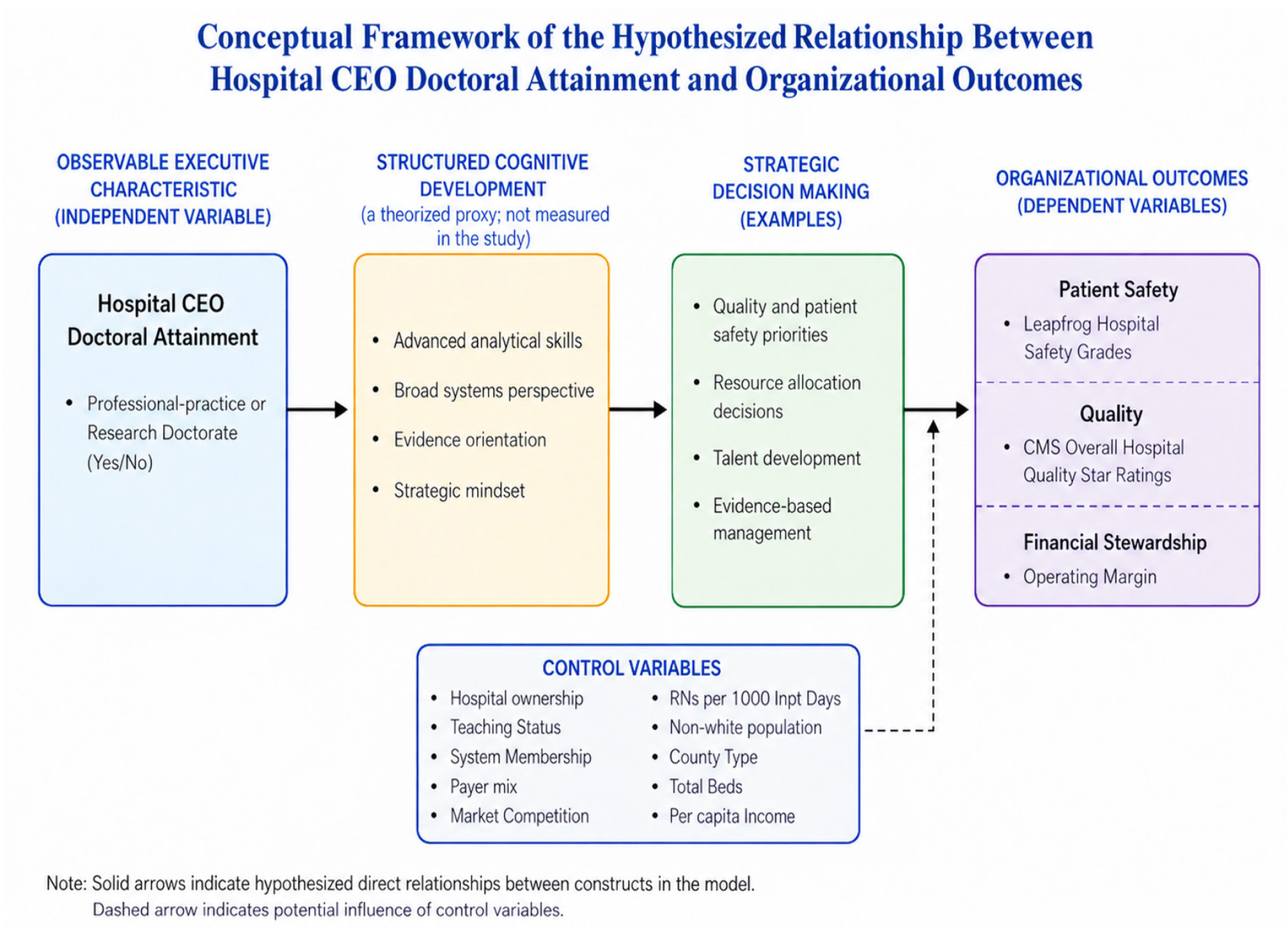
Figure 1.
Conceptual framework informed by Upper Echelons Theory
Guided by UET and the strategic leadership literature, doctoral education may enhance analytical reasoning, systems thinking, and evidence-informed decision-making, thereby strengthening organizational structures and processes that support patient safety and clinical quality.[7, 40, 41] On this basis, hospitals led by CEOs with doctoral attainment are expected to demonstrate superior patient safety and quality outcomes.
The following hypotheses were tested:
H1: Hospitals led by CEOs with doctoral attainment will report higher Leapfrog Hospital Safety Grades than hospitals led by CEOs without doctoral attainment.
H2: Hospitals led by CEOs with doctoral attainment will report higher CMS Overall Hospital Quality Star Ratings than hospitals led by CEOs without doctoral attainment.
Financial performance, however, reflects a broader set of strategic trade-offs than patient safety and clinical quality alone do. Hospital CEOs must continually balance investments in workforce development, facility infrastructure, capital allocation, and regulatory compliance against the expectation of strong and sustained financial performance.[42] UET suggests that educational attributes may influence how executives evaluate competing priorities and make strategic decisions regarding organizational resources.[43, 44] Despite positive associations between CEO educational attainment and financial outcomes reported in the international strategic leadership literature, this relationship has received limited empirical attention in U.S. hospitals. Therefore, the association between hospital CEO doctoral attainment and operating margin is an important empirical question. Based on the preceding rationale, the following hypothesis was tested:
H3: Hospitals led by CEOs with doctoral attainment will report higher operating margins than hospitals led by CEOs without doctoral attainment.
2.Methods
2.1Data sources
Data were obtained from the 2016 and 2019 American Hospital Association (AHA) Annual Surveys, 2019 Medicare Cost Reports (MCRs), the 2019 Area Health Resources Files (AHRF), the Centers for Medicare & Medicaid Services (CMS) Hospital Compare database, the Leapfrog Hospital Safety Grades database, Becker’s Hospital Review, hospital executive biographies and press releases identified through Google searches, individual hospital websites, and LinkedIn.
The AHA Annual Survey served as the primary source for identifying the study population and hospital organizational characteristics. The survey contains organizational, operational, staffing, utilization, and executive information for more than 6,200 U.S. hospitals and approximately 400 health systems. Hospital CEO tenure was determined by comparing the 2016 and 2019 AHA Annual Surveys. Hospitals were included only if the same individual was listed as CEO (or equivalent title) in both survey years, thereby establishing four consecutive years of continuous CEO tenure. Executive names and titles were manually verified across both survey years, and all abstracted data were independently verified against the source before inclusion in the analytic dataset to ensure accuracy and consistency. The 2019 AHA Annual Survey also provided organizational characteristics used in the analyses, including registered nurses per 1,000 inpatient days, teaching hospital status, ownership type, total staffed beds, and system membership.
Hospital operating margin was obtained from the 2019 Medicare Cost Reports. County-level market and demographic characteristics were obtained from the 2019 Area Health Resources File, including Medicaid and Medicare payer mixes, per capita income, market competition measured by the Herfindahl–Hirschman Index (HHI), population characteristics, and urbanicity.
Hospital patient safety and quality outcomes were obtained from nationally recognized public performance databases. Leapfrog Hospital Safety Grades were obtained from the Spring 2020 reporting cycle, and the CMS Overall Hospital Quality Star Ratings were obtained from the July 2022 CMS Hospital Compare release. These reporting cycles were selected because their underlying measurement periods corresponded to calendar year 2019 hospital performance and excluded data influenced by the COVID-19 pandemic. Hospital Safety Grades were abstracted directly from the Leapfrog website.
Hospital CEO doctoral attainment was determined using multiple publicly available sources, including Becker’s Hospital Review, executive biographies and organizational announcements, individual hospital websites, and LinkedIn profiles. When educational credentials were incomplete or inconsistent across sources, additional sources were reviewed to verify each CEO’s highest completed degree before classification, thereby minimizing potential misclassification.
Although secondary data sources are subject to reporting errors and variable data completeness, they are used in health services research and provide a transparent, standardized, and reproducible foundation for evaluating hospital organizational performance.
2.2Study population
The acute-care hospital served as the unit of analysis. The final study population consisted of 509 U.S. acute-care hospitals led by CEOs who served continuously from 2016 through 2019. Restricting the study to CEOs with four consecutive years of tenure increased confidence that 2019 organizational performance reflected sustained executive leadership rather than a recent leadership transition.
To enhance geographic representation, hospitals were selected from one state within each of the nine U.S. Census Bureau divisions, collectively representing all four U.S. Census regions: Northeast, Midwest, South, and West.[45] The selected states were California, Colorado, Florida, Illinois, Kansas, Massachusetts, Pennsylvania, Tennessee, and Texas. State selection was based on the 2019 AHA Annual Survey, with each selected Census division including the state with the largest number of eligible acute-care hospitals. This sampling strategy enhanced cross-regional diversity while maximizing the number of eligible hospitals. State fixed effects were included in all multivariable regression models to account for unobserved state-level differences.
Eligible hospitals included investor-owned, nonprofit, and nonfederal public acute-care hospitals with more than 50 staffed beds. Hospitals with 50 or fewer staffed beds were excluded because smaller hospitals differ substantially from larger acute-care hospitals in service capacity, staffing requirements, patient volume, and financial characteristics.[46] This threshold improved comparability across the study population. Teaching hospitals and hospitals affiliated with multihospital systems were included.
Critical access hospitals (25 beds or fewer) were excluded because their financing, staffing structures, and service capabilities differ substantially from those of larger acute-care hospitals. Specialty hospitals, including children’s and cancer hospitals, were excluded because their narrowly defined patient populations, service portfolios, reimbursement structures, and performance profiles limit comparability with general acute-care hospitals. Veterans Affairs and military hospitals were excluded because they operate within federal governance, financing, and accountability systems that differ from those of civilian hospitals. Long-term care facilities, rehabilitation hospitals, and ambulatory care centers were excluded because they do not provide the same scope of inpatient acute-care services or share comparable organizational performance measures. Hospitals located in U.S. territories were excluded to maintain consistency with the state-based sampling framework and the U.S. Census regional and divisional classifications used in the study.
2.3Measures
Organizational performance was evaluated across three complementary domains—patient safety, hospital quality, and financial stewardship—using the Leapfrog Hospital Safety Grade, the CMS Overall Hospital Quality Star Rating, and operating margin, respectively. These outcome measures capture distinct yet interrelated dimensions of hospital performance that are recognized by hospital CEOs, hospital governing boards, healthcare executive search firms, and health services researchers.[47, 48] The study defined and categorized variables a priori, based on the conceptual framework and prior research in health services and strategic leadership, to minimize investigator discretion and promote methodological consistency.
2.3.1Dependent variables
Patient Safety. Patient safety was measured using the Leapfrog Hospital Safety Grade, a nationally recognized publicly reported outcome evaluating hospital performance in preventing medical errors, patient injuries, and avoidable harm, using a transparent, peer-reviewed methodology based on evidence-based measures.[49] Consistent with prior health services research and established reporting conventions, hospitals receiving grades of A or B were classified as high-performing (coded 1), whereas hospitals receiving grades of C through F were classified as lower-performing (coded 0). This a priori categorization reflects accepted distinctions in the literature between hospitals demonstrating higher and lower levels of patient safety performance.[50]
Hospital Quality. Hospital quality was measured using the Centers for Medicare & Medicaid Services (CMS) Overall Hospital Quality Star Rating. This nationally recognized composite rating summarizes hospital performance across five quality domains: mortality, safety of care, readmission, patient experience, and timely and effective care into a single overall star rating. By integrating multiple standardized performance measures using a transparent methodology, the Overall Hospital Quality Star Rating provides a comprehensive assessment of clinical quality and has become an established outcome measure in health services research evaluating hospital performance.[51] Consistent with prior health services research, hospitals receiving four or five stars were classified as high-performing (coded 1), whereas hospitals receiving one through three stars were classified as lower-performing (coded 0). This a priori dichotomization reflects established distinctions in the literature between hospitals demonstrating higher and lower overall quality performance and was adopted to maintain consistency with previous investigations.[52]
Financial Stewardship. Financial stewardship was evaluated using hospital operating margin. Operating margin was selected because it reflects financial performance derived from a hospital’s core patient care operations. Unlike total margin, which may be substantially influenced by investment income, philanthropy, asset sales, and other nonoperating revenue sources, operating margin more directly assesses executive stewardship of routine hospital operations. Because hospital CEOs are primarily responsible for allocating organizational resources and maintaining financial viability, operating margin is an appropriate measure of executive financial stewardship. Operating margin was calculated as operating income divided by net operating revenue and expressed as a percentage. To reduce the influence of extreme observations, operating-margin values exceeding three standard deviations from the mean were excluded before standardization. The remaining values were then standardized to produce a z-scored operating-margin measure. Accordingly, the regression coefficient represents the adjusted difference in operating margin, expressed in standard-deviation units, between hospitals led by CEOs with and without doctoral attainment. Operating margin is an established and widely used measure of hospital financial performance and is commonly used in health services research.[47]
2.3.2Independent variable
The primary independent variable, CEO doctoral attainment, was defined a priori as a dichotomous variable, coded 1 for CEOs who had completed a doctoral degree and 0 for those who had not. Consistent with the study’s construct definition, both professional-practice and research doctorates were included within the doctoral-attainment category. This measure captures level of formal educational attainment rather than doctoral pathway or disciplinary specialization. Doctoral pathways were examined separately in sensitivity analyses to assess potential heterogeneity within the broader doctoral-attainment measure.
2.3.3Covariates
The multivariable models adjusted a priori for organizational and market characteristics previously associated with hospital performance in the health services and strategic leadership literature.[15] Organizational covariates included ownership type, teaching hospital status, total staffed beds, registered nurses per 1,000 inpatient days, and system membership. Market and community covariates included urbanicity, operationalized using county type (metropolitan versus nonmetropolitan), Medicaid payer mix, Medicare payer mix, market competition (HHI), non-White population percentage, and county per capita income. These covariates were selected because prior research has consistently demonstrated that they are associated with variation in hospital patient safety, quality, and financial performance independent of executive characteristics and therefore may confound the relationship between CEO doctoral attainment and organizational performance.[34, 53] Each covariate was included in all multivariable regression models to estimate the independent association between CEO doctoral attainment and each of the study’s organizational performance outcomes.
2.4Statistical analysis
Descriptive statistics summarized study variables and evaluated data quality, including missing values, variable distributions, and potential outliers. Multicollinearity among the independent variable and covariates was assessed using variance inflation factors (VIFs) and tolerance statistics. Statistical significance was established a priori at a two-sided
Baseline characteristics of hospitals led by CEOs with and without doctoral attainment were compared using independent-samples
Binary logistic regression was used to examine the associations between CEO doctoral attainment and the dichotomized patient safety and hospital quality outcomes (Leapfrog Hospital Safety Grades and CMS Overall Hospital Quality Star Ratings). Ordinary least squares (OLS) regression examined the association between CEO doctoral attainment and the continuous financial outcome of operating margin.
The study population consisted of 509 U.S. acute-care hospitals. Analytic sample sizes differed across outcome models because some hospitals lacked outcome data in the CMS Hospital Compare, Leapfrog Hospital Safety Grades, and Medicare Cost Report databases. For each outcome, all hospitals that met the prespecified eligibility criteria and had available outcome data were included in the corresponding analysis. No additional case exclusions were made beyond the study eligibility criteria and the prespecified operating-margin outlier procedure. Consequently, differences in analytic sample size reflect source-specific data availability rather than selective hospital inclusion.
All statistical analyses were performed using StataSE 19.
2.5Sensitivity analyses
2.5.1Sensitivity analysis of missing data
Operating margin data were unavailable for 123 hospitals, resulting in a complete-case analytic sample of 386 hospitals for the primary OLS analysis. Because the proportion of missing operating margin data could introduce bias, a sensitivity analysis was conducted using multiple imputation with predictive mean matching (PMM). The PMM procedure generated plausible values for missing operating margin observations based on the observed relationships among the study variables while preserving the distribution of the observed data. The sensitivity analysis yielded results that were substantively consistent with the complete-case analysis, with the direction, magnitude, and statistical significance of the association between CEO doctoral attainment and operating margin remaining unchanged. Therefore, the complete-case analysis is presented because it produced conclusions consistent with those obtained from the multiple imputation sensitivity analysis. Sensitivity analyses were not performed for the Leapfrog Hospital Safety Grade or CMS Overall Hospital Quality Star Rating outcomes because missing outcome data for those measures were substantially less extensive than for operating margin.
2.5.2Sensitivity analyses by doctoral degree type and physician status
To assess potential heterogeneity within the doctoral-attainment exposure variable, two complementary sensitivity analyses were conducted. First, CEO doctoral status was decomposed into three categories: no doctoral degree, professional-practice doctorate, and research doctorate. Second, CEO doctoral status was decomposed into no doctoral degree, physician CEO (DO or MD), and nonphysician CEO with a doctoral degree. For each analysis, CEOs without a doctoral degree served as the reference group, and the fully adjusted Leapfrog, CMS Star, and operating-margin models were re-estimated using the same covariate specifications and state fixed effects as the primary analyses. Wald tests evaluated whether the estimated associations differed between professional-practice and research doctorates and between physician and nonphysician CEOs with doctoral degrees.
2.5.3Sensitivity analyses of nonrandom selection and omitted-variable bias
To assess nonrandom selection into CEO doctoral attainment, inverse-probability weighting (IPW) was performed using propensity scores estimated from hospital ownership, payer mix, county type, market concentration, community characteristics, system membership, teaching status, and bed size. The treatment model also included ownership-by-payer-mix interactions and a quadratic Medicaid payer-mix term to improve covariate balance. Average treatment effects were estimated with robust standard errors, and balance was evaluated using standardized mean differences, omnibus balance tests, and propensity-score overlap.
Potential omitted-variable bias in the OLS operating-margin model was further examined using the Oster coefficient-stability approach.[54] The analysis estimated
2.6Ethical considerations
This study analyzed publicly available, secondary data and did not involve human subjects. This study was declared “not research involving human subjects” by the University Institutional Review Board (IRB) based on the definitions provided in the U.S. Department of Health and Human Services Code of Federal Regulations found at 45 CFR 46.102. Accordingly, this project qualified for a Waiver of IRB Review. The waiver did not absolve the researchers of the obligation to comply with other federal, state, or local laws or institutional policies and procedures applicable to the conduct of this project.
3.Results
3.1Associations across hospital performance domains
The study sample consisted of 509 U.S. acute-care hospitals. Among hospital CEOs, 17% (
| Total staffed beds, mean (SD) | 278.7 (273.8) |
| Registered nurses per 1,000 inpatient days, mean (SD) | 2.2 (3.1) |
| Teaching hospital, |
332 (65.2) |
| System membership, |
388 (76.2) |
| Ownership type, |
|
| Investor-owned | 117 (23.0) |
| Not-for-profit | 336 (66.0) |
| Government-owned (nonfederal) | 56 (11.0) |
| Herfindahl–Hirschman Index, mean (SD) | 30.9 (30.0) |
| Medicaid payer mix, mean (SD) | 20.3 (11.6) |
| Medicare payer mix, mean (SD) | 51.0 (12.2) |
| Non-White population, mean (SD) | 47.0 (23.0) |
| Per capita income ($000s), mean (SD) | 58.9 (19.9) |
| County type, |
|
| Metropolitan | 469 (92.1) |
| Nonmetropolitan | 40 (7.9) |
| Doctoral attainment, |
86 (16.9) |
| No doctoral attainment, |
423 (83.1) |
Table 2 presents baseline characteristics of hospitals led by CEOs with and without doctoral attainment. Hospital size, ownership type, Medicaid payer mix, and Medicare payer mix differed, whereas the remaining measured hospital, market, and community characteristics did not differ significantly between groups. These variables, together with the remaining prespecified covariates, were included in the multivariable regression models to estimate the independent association between CEO doctoral attainment and organizational performance.
| Total staffed beds, mean (SD) | 266.6 (269.5) | 338.1 (288.2) | |
| Registered nurses per 1,000 inpatient days, mean (SD) | 2.24 (3.16) | 2.06 (2.88) | .615 |
| Teaching hospital | .142 | ||
| No | 153 (36.2%) | 24 (27.9%) | |
| Yes | 270 (63.8%) | 62 (72.1%) | |
| System membership | .145 | ||
| No | 95 (22.5%) | 26 (30.2%) | |
| Yes | 328 (77.5%) | 60 (69.8%) | |
| Ownership type | |||
| Investor-owned | 107 (25.3%) | 10 (11.6%) | |
| Not-for-profit | 277 (65.5%) | 59 (68.6%) | |
| Government-owned (nonfederal) | 39 (9.2%) | 17 (19.8%) | |
| Herfindahl–Hirschman Index, mean (SD) | 31.3 (30.4) | 29.1 (28.4) | .534 |
| Medicaid payer mix, mean (SD) | 19.7 (11.1) | 23.4 (13.3) | |
| Medicare payer mix, mean (SD) | 51.7 (11.2) | 47.9 (15.8) | |
| Non-White population, mean (SD) | 46.7 (23.2) | 48.7 (22.3) | .468 |
| Per capita income ($000s), mean (SD) | 58.2 (19.2) | 62.2 (22.8) | .101 |
| County type | .118 | ||
| Nonmetropolitan | 37 (8.7%) | 3 (3.5%) | |
| Metropolitan | 386 (91.3%) | 83 (96.5%) |
Table 3 presents the associations between hospital CEO doctoral attainment and the three organizational performance outcomes after adjustment for organizational and market covariates. Hospitals led by CEOs with doctoral attainment had significantly greater odds of earning an A or B Leapfrog Hospital Safety Grade than hospitals led by CEOs without doctoral attainment (OR = 1.87,
| 0.57 | .041 | 0.12 | .002 | 1.35 (0.8–2.27) | 0.36 | .268 | |||
| County type | 1.09 (0.412–2.87) | 0.53 | .867 | 0.21 (−0.19–0.62) | 0.21 | .304 | 0.82 (0.34–1.97) | 0.37 | .656 |
| HHI | 0.99 (0.97–1.00) | 0.01 | .083 | 0.001 (−0.004–0.007) | 0.003 | .714 | 1.00 (0.99–1.01) | 0.01 | .972 |
| Medicaid payer mix | 0.04 | .005 | –1.05 (−2.3–0.19) | 0.64 | .098 | 0.07 (0.01–1.03) | 0.10 | .053 | |
| Medicare payer mix | 0.85 (0.08–8.71) | 1.01 | .895 | 0.27 (−0.75–1.28) | 0.52 | .608 | 2.42 (0.28–21.11) | 2.67 | .424 |
| Non-White population | 0.72 (0.15–3.33) | 0.56 | .673 | 0.02 (−0.63–0.68) | 0.33 | .944 | 0.43 (0.1–1.89) | 0.32 | .264 |
| Ownership type | Investor-owned | Investor-owned | Investor-owned | ||||||
| Not-for-profit | 0.64 (0.36–1.15) | 0.19 | .138 | 0.12 | .001 | 0.53 | .014 | ||
| Government-owned (nonfederal) | 0.17 | .033 | 0.18 | .001 | 1.84 (0.80–4.19) | 0.77 | .149 | ||
| Per capita income | 1.00 (0.98–1.01) | 0.01 | .690 | −0.001 (−0.00672–0.00489) | 0.003 | .757 | 1.01 (0.97–1.02) | 0.01 | .163 |
| RNs per 1,000 inpatient days | 1.12 (0.99–1.28) | 0.07 | .076 | 0.03 (−0.03–0.08) | 0.03 | .328 | 1.01 (0.90–1.13) | 0.06 | .901 |
| System membership | 1.67 (0.99–2.82) | 0.45 | .055 | 0.12 | .001 | 1.58 (0.95–2.63) | 0.41 | .080 | |
| Teaching hospital | 0.93 (0.57–1.51) | 0.23 | .763 | −0.19 (−0.39–0.02) | 0.11 | .076 | 0.13 | .013 | |
| Total staffed beds | 1.00 (0.99999–1.00226) | 0.001 | .053 | 0.001 (−0.0001–0.001) | 0.001 | .724 | 0.001 | .032 | |
| 467 | 386 | 493 | |||||||
| Pseudo |
0.07 | 0.09 | |||||||
| Adjusted |
0.24 | ||||||||
| LR χ² (logistic models) | 40.54 | 59.96 | |||||||
| State fixed effects | Yes | Yes | Yes |
Hospitals led by CEOs with doctoral attainment had, on average, lower operating margins than those led by CEOs without doctoral attainment (
In contrast, no statistically significant association was observed between hospital CEO doctoral attainment and CMS Overall Hospital Quality Star Ratings after adjustment for organizational and market covariates.
3.2Sensitivity analyses
3.2.1Sensitivity analysis of missing data
PMM was used to assess the sensitivity of the operating-margin findings to missing outcome data. After imputation of 123 missing operating-margin observations, the association between CEO doctoral attainment and standardized operating margin remained negative and statistically significant (
3.2.2Sensitivity analyses by doctoral degree type and physician status
Decomposition of doctoral attainment into professional-practice and research doctoral degrees demonstrated heterogeneity for operating margin. Professional-practice doctoral attainment was associated with a lower standardized operating margin than no doctorate, whereas research doctoral attainment was not significantly associated with operating margin. The difference between professional-practice and research doctoral coefficients was statistically significant (Wald
Decomposition by physician status also showed heterogeneity in operating margin. Physician CEOs were associated with a lower standardized operating margin than CEOs without doctoral degrees, whereas nonphysician CEOs with doctoral degrees were not significantly associated with operating margin. The difference between physician and nonphysician doctoral coefficients was statistically significant (Wald
3.2.3Sensitivity analyses of nonrandom selection and omitted-variable bias
Inverse-probability weighting substantially improved balance in observed hospital characteristics associated with CEO doctoral attainment. Across all three outcome-specific samples, post-weighting absolute standardized mean differences were < 0.10, including for hospital ownership and Medicaid payer mix, and omnibus tests indicated satisfactory covariate balance for operating margin (
The Oster coefficient-stability analysis further evaluated potential omitted-variable bias in the operating-margin model. With the maximum
4.Discussion
4.1Interpretation of findings
The findings provide partial support for Upper Echelons Theory, indicating that hospital CEO doctoral attainment was associated with selected, but not all, dimensions of organizational performance. Specifically, doctoral attainment was positively associated with patient safety, associated with lower operating margins on average, and was not associated with CMS Overall Hospital Quality Star Ratings. The observed pattern suggests that CEO doctoral attainment may be associated differently across dimensions of hospital performance rather than uniformly across outcomes. Because this is a cross-sectional study, these associations should not be interpreted as causal.
The doctoral degree-type and physician-status sensitivity analyses provide additional context for interpreting the doctoral-attainment construct. Both decompositions identified heterogeneity in the association with operating margin. The negative association was concentrated among CEOs holding professional-practice doctorates in the degree-type analysis and among physician CEOs in the physician-status analysis, whereas research-doctorate and nonphysician-doctorate groups were not significantly associated with operating margin. Neither of the decomposition analyses identified significant between-group heterogeneity for Leapfrog nor CMS Star performance. These findings suggest that heterogeneity within the broader doctoral-attainment construct may be particularly relevant to financial performance. Because doctoral pathway and physician status represent overlapping classifications, these analyses should be interpreted as complementary rather than as isolating the independent contribution of either characteristic.
The principal finding was the significant and positive association between CEO doctoral attainment and Leapfrog Hospital Safety Grades. To our knowledge, few contemporary studies have directly examined the association between hospital CEO educational attainment and Leapfrog Hospital Safety Grades. A recent study of U.S. academic hospitals found no significant association between CEOs’ educational backgrounds and Leapfrog performance.[34] Similarly, See et al. found no significant association between physician CEO status and Leapfrog Hospital Safety Grades in a large national sample of U.S. hospitals.[55]
Within the UET framework, doctoral education may enhance executives’ analytical reasoning, systems thinking, and evidence-informed decision-making, thereby influencing organizational priorities and strategic choices relevant to patient safety.[56, 57] Because the Leapfrog Hospital Safety Grade predominantly captures organizational safety structures, clinical processes, and patient outcomes that occur within the hospital and is influenced by leadership priorities,[49] this outcome measure may be especially sensitive to differences in executive strategic decision-making.
The observed association between CEO doctoral attainment and lower operating margins, on average, was contrary to the hypothesized relationship. Although the negative association remained statistically significant after adjustment for organizational, market, and community characteristics, the mechanisms underlying this relationship remain uncertain. This finding stands in marked contrast to the international strategic leadership literature, which has predominantly associated CEO doctoral education with stronger financial performance. One possible explanation is that CEOs with doctoral education may prioritize longer-term investments in patient safety, workforce development, facility infrastructure, capital allocation, or organizational capability, with financial returns that may not be realized within the cross-sectional study period.[58] The lower operating-margin association was concentrated among CEOs in the overlapping physician and professional-practice doctoral subgroup; however, the present analyses cannot determine whether this heterogeneity reflects physician status, doctoral pathway, or other characteristics associated with these hospital CEOs. Alternative explanations, including unmeasured organizational characteristics, endogeneity and market dynamics, cannot be ruled out and warrant further investigation through longitudinal study designs.
No significant association was observed between CEO doctoral attainment and CMS Overall Hospital Quality Star Ratings. Unlike the Leapfrog Hospital Safety Grade, which largely evaluates patient safety culture, infrastructure, and programming within the hospital environment, the CMS Overall Hospital Quality Star Ratings capture performance across multiple dimensions of the care continuum, including mortality, readmissions, patient experience, and the timeliness and effectiveness of care. UET does not imply that executive educational characteristics influence all organizational outcomes equally. Instead, doctoral attainment may matter more in settings where executives have greater managerial discretion.[59, 60] Consequently, the absence of an observed association suggests that the influence of doctoral attainment may be less discernible within a broad composite quality measure shaped by multiple organizational, clinical, and environmental factors that extend beyond executive leadership discretion within the hospital.
These results have practical relevance for hospital boards and healthcare executive search firms involved in CEO recruitment and selection. Boards should first identify the hospital’s most pressing strategic priorities, such as striving for higher levels of patient safety, clinical quality improvement, or stronger financial performance. Boards and search firms can then evaluate doctoral attainment alongside demonstrated professional experience, core leadership competencies, relevant credentials and certifications, and a record of impactful performance to assess alignment with those priorities. Doctoral attainment should therefore be considered as one component of executive-organizational fit rather than as a stand-alone selection criterion.
4.2Limitations
Several limitations should be considered when interpreting the findings. First, the cross-sectional observational design precludes causal inference. Although requiring four consecutive years of CEO tenure strengthened the temporal alignment between executive leadership and organizational outcomes, the analyses identified associations between CEO doctoral attainment and hospital performance but cannot establish causality.
Second, the primary analysis examined doctoral attainment as a unified executive educational characteristic rather than as separate professional-practice and research doctoral pathways, or as distinct physician and nonphysician professional backgrounds. This approach was intentional and consistent with the study’s theoretical focus on doctoral attainment as an observable senior executive characteristic. This study makes clear that professional-practice and research doctorates differ in disciplinary orientation, curricular emphasis, and training experiences, while physician and nonphysician CEOs with doctoral degrees may differ in clinical preparation, professional socialization, and organizational authority. Because physician status and doctoral pathway overlap substantially in this sample, the degree-type and physician-status sensitivity analyses cannot fully disentangle these two dimensions from one another. Therefore, the observed associations should be interpreted as reflecting doctoral attainment broadly, rather than any specific doctoral discipline, pathway, or professional background. Additionally, this study measured doctoral attainment as a completed credential and did not assess characteristics of doctoral preparation, including program quality, curricular emphasis, institutional context, or academic performance.
Third, residual confounding and non-random CEO selection remain possible despite adjustment for a comprehensive set of hospital, market, and community characteristics. Hospitals that appoint CEOs with doctoral education may differ systematically in unmeasured characteristics, such as governance priorities, organizational culture, executive team composition, or strategic orientation, that may also influence organizational performance (e.g., endogeneity). The observed associations may reflect both the selected executive educational characteristic and unmeasured organizational factors; therefore, causal interpretations should be avoided.
Fourth, the sampling frame included hospitals from one state within each U.S. Census division and excluded hospitals with 50 or fewer staffed beds and selected specialty and federal facilities; therefore, the findings may not generalize to all U.S. hospitals.
Finally, CEO educational credentials were derived from publicly available professional sources and may remain subject to residual misclassification; the timing of doctoral degree completion relative to CEO tenure was not evaluated.
4.3Considerations for future research
The present findings provide a foundation for further investigation of CEO doctoral attainment and hospital performance. Longitudinal studies following hospitals across executive transitions could strengthen temporal inference, examine managerial discretion, and determine whether observed associations change with executive tenure. Further research should evaluate heterogeneity by doctoral pathway and physician status using larger samples that permit simultaneous evaluation of educational pathway and professional background. Such studies could further disaggregate professional-practice doctorates by physician status and determine whether the observed operating-margin heterogeneity is principally associated with physician status, professional doctoral preparation, or other overlapping characteristics. Future research should also investigate whether characteristics of doctoral preparation, including program quality, curricular emphasis, institutional context, and academic performance, are associated with the effectiveness of executive decision-making and organizational performance beyond doctoral attainment alone.
Additional research should characterize the organizational mechanisms through which doctoral attainment may be associated with hospital performance, including strategic decision-making, governance relations, physician alignment, workforce engagement, innovation, technology adoption (e.g., artificial intelligence), community partnership development, and financial stewardship. More standardized data on hospital executive educational characteristics would also improve reproducibility and support more rigorous longitudinal and multilevel analyses. This could be achieved through a standardized, publicly accessible repository that systematically captures hospital executive educational credentials, professional backgrounds, and leadership characteristics across institutions and over time. Future multilevel studies should also assess whether health system affiliation and system-level performance modify the relationship between CEO doctoral attainment and hospital outcomes, including whether shared system resources and capabilities attenuate performance differences at the individual-hospital level. Finally, integrating UET with complementary frameworks such as Human Capital Theory, the managerial discretion perspective, the Resource-Based View, and Expert Leadership Theory may offer a more powerful explanation of how executive educational characteristics shape strategic judgment, organizational priorities, and ultimately, organizational performance.
5.Conclusion
This study examined the relationship between hospital CEO doctoral attainment and multiple dimensions of organizational performance among U.S. acute-care hospitals. CEO doctoral attainment was significantly and positively associated with patient safety, associated with lower operating margins on average, and not significantly associated with CMS Overall Hospital Quality Star Ratings. Taken together, these results indicate that the relationship between executive doctoral attainment and hospital performance is domain-specific rather than uniform, with associations differing across patient safety, quality, and financial outcomes.
The study extends and reorients the strategic healthcare leadership literature in the U.S. by shifting attention from professional background and physician status toward doctoral attainment as a distinct executive educational characteristic. Consistent with UET, the results demonstrate that a single observable executive characteristic may be associated differently with specific organizational outcomes. By reframing doctoral attainment as a theoretically and empirically distinct executive educational characteristic, this study provides a foundation for more precise examination of its relationship with hospital performance. Further healthcare strategic leadership research should consider not only whether hospital CEO doctoral attainment matters, but also where, how, and under what organizational conditions it matters, and what those relationships ultimately mean for the patients hospitals serve.
Authors contributions
All authors contributed to the design, drafting and final approval of the version to be published. KC: Conception and analyzing data.
Funding
This research received no specific grant from any funding agency in the public, commercial, or non-profit sectors.
Conflicts of Interest Disclosure
The authors declare they have no conflicts of interest.
Informed consent
Not applicable.
Ethics approval
The Publication Ethics Committee of the Association for Health Sciences and Education. The journal’s policies adhere to the Core Practices established by the Committee on Publication Ethics (COPE).
Provenance and peer review
Not commissioned; externally double-blind peer reviewed.
Data availability statement
The data used in this study were obtained from publicly available sources.
Data sharing statement
Data supporting the findings of this study are available from the corresponding author upon reasonable request.
Acknowledgements
None.
References
- American Hospital Association. Hospitals and health systems squeezed by persistent economic challenges. 2025. https://www.aha.org/press-releases/2025-04-30-new-aha-report-hospitals-and-health-systems-squeezed-persistent-economic-challenges
- Spanos S, Leask E, Patel R. Healthcare leaders navigating complexity: a scoping review of key trends in future roles and competencies. BMC Med Educ. 2024;24(1):720. doi:10.1186/s12909-024-05689-4
- Vogus T, Lee M, Mossburg S. High Reliability Organization (HRO) Principles and Patient Safety. 2025.
- Dye C. Leadership in healthcare: Essential values and skills. Chicago, IL; ACHE Learn. 2023.
- WittKieffer. Healthcare CEO Reimagined: Leading Healthcare’s Next Chapter. 2025. https://wittkieffer.com/insights/healthcare-ceo-reimagined
- Belasen A, Belasen A, Feng Z. The physician CEO advantage and hospital performance during the COVID-19 pandemic: capacity utilization and patient satisfaction. Journal of Health Organization and Management. 2023;37(3):313-26. doi:10.1108/JHOM-04-2022-0126
- He Z, Hirshleifer D. The Exploratory Mindset and Corporate Innovation. Journal of Financial and Quantitative Analysis. 2022;57(1):127-69. doi:10.1017/S0022109020000800
- Mohmad S, Lee K, Bakit P. Do health-care institutions perform better under leaders with medical or non-medical backgrounds? A scoping review. Leadership in Health Services. 2024;37(5):142-56. doi:10.1108/LHS-11-2023-0084
- Howard S, Counte M, Alzeen M. Hospital Performance Assessment: A Global Perspective. Quality Management in Healthcare. 2026;35(3):141-52. doi:10.1097/QMH.0000000000000552
- Zuchowski M, Henzler D, Alscher M. The impact of C-level positions on hospital performance: A scoping review of top management team outcomes. Health Policy. 2025;157:105346. doi:10.1016/j.healthpol.2025.105346
- Akande J, Atiba S. Effectiveness of Hospital Workers in Leadership Positions. Nigerian Stethoscope. 2025;7(1):42-55.
- Farmer F. The relationship between physician versus non-physician CEOs, tenure, and hospital outcomes. Charlotte, NC; The University of North Carolina at Charlotte. 2025.
- Goodall A. Physician-leaders and hospital performance: is there an association?. Social Science & Medicine. 2011;73(4):535-9. doi:10.1016/j.socscimed.2011.06.025
- Buren C. Comparison of Quality Measures from US Teaching Hospitals with Clinically Trained and Non-Clinically Trained Executives. Philadelphia, PA; University of Pennsylvania. 2024.
- Galstian C, Hearld L, O’Connor S. The relationship of hospital CEO characteristics to patient experience scores. Journal of Healthcare Management. 2018;63(1):50-61. doi:10.1097/JHM-D-16-00020
- American College of Healthcare Executives. Which degree should I pursue?. Chicago, IL; American College of Healthcare Executives. https://www.ache.org/career-resource-center/special-groups/resources-for-students-and-early-careerists/which-degree-should-i-pursue
- Crist Kolder Associates. Volatility Report 2023. 2023.
- Cash K. Does CEO Education Matter? The Relationship Between Doctoral-Educated Hospital CEOs and Organizational Performance [Doctorate Dissertation]. Birmingham, AL; The University of Alabama at Birmingham. 2024.
- Hambrick D, Mason P. Upper Echelons: The Organization as a Reflection of Its Top Managers. The Academy of Management Review. 1984;9(2):193-206. doi:10.2307/258434
- Hambrick D. Upper echelons theory: An update. 2007;32(2):334-43. doi:10.5465/amr.2007.24345254
- Ludigdo U, Prihatiningtias Y, Zakaria Z. Strategic integration of CSR, innovation-performance models, and upper echelon theory for predicting green business performance in Indonesia’s hospitality industry. 2025;12(1):2538708. doi:10.1080/23311975.2025.2538708
- Perkins S, Shortland S. Upper echelons theory. A guide to key theories for human resource management research. Edited by Hutchings K, Michailova S, Wilkinson A. Cheltenham, UK; Edward Elgar Publishing. 2024: 325-31. doi:10.4337/9781035308767.ch43
- Wu L, Fang J. How higher education affects corporate human capital investment: Based on Upper Echelons Theory. Finance Research Letters. 2024;69:106019. doi:10.1016/j.frl.2024.106019
- Aifuwa H, Gideon P. Do CEO gender and educational background affect financial performances of hotel in Nigeria?. Annals of Spiru Haret University. 2022;22(1):357-70. doi:10.2139/ssrn.4103537
- Silvina S, Robin R, Yuwono W. The impact on firm performance: evidence from CEO education. Inovasi: Jurnal Ekonomi, Keuangan, dan Manajemen. 2022;18(1):176-84. doi:10.30872/jinv.v18i1.10477
- Thoebes G, Porter T, Peck J. Physicians as leaders: a systematic review through the lens of expert leadership. Leadership in Health Services. 2024;37(1):95-111. doi:10.1108/LHS-02-2023-0008
- Zagudalova E, Grigorieva S, Zueva S. Does the education and experience of CEO matter? Evidence from M&As initiated by the Russian companies. Journal of the New Economic Association, New Economic Association. 2024;64(3):103-127. doi:10.31737/22212264_2024_3_103-127
- Zhou M, Chen F, Chen Z. Can CEO education promote environmental innovation: Evidence from Chinese enterprises. Journal of Cleaner Production. 2021;297:126725. doi:10.1016/j.jclepro.2021.126725
- Altuwaijri B, Kalyanaraman L. CEO education-performance relationship: Evidence from Saudi Arabia. The Journal of Asian Finance, Economics and Business. 2020;7(8):259-68. doi:10.13106/jafeb.2020.vol7.no8.259
- Robbani K, Hasnawati H, Dewi R. The Effect of CEO Education, CEO Tenure, Company Risk, and Environmental Performance on Company Value. Indonesian Management and Accounting Research. 2024;23(1):109-36. doi:10.25105/imar.v23i1.19034
- Sugiharto M, Probohudono A, Suhardjanto D. A bibliometric analysis of evolving trends in CEO characteristics and financial performance research. 2024;11(1):2381089. doi:10.1080/23311975.2024.2381089
- Susilo B, Usman B, Lestari H. The Influence of CEO Characteristics, Risk Management, Financial Digitalization and Exchange Rate on Bank Performance Moderated by Interest Rate In Indonesia. Asian Journal of Management, Entrepreneurship and Social Science. 2025;5(01):329-53.
- Trinh V, Elnahass M, Pasiouras F. Personal traits of CEOs and cybersecurity-related disclosure. Journal of International Accounting, Auditing and Taxation. 2025;58:100680. doi:10.1016/j.intaccaudtax.2025.100680
- Razick D, Monroe R, Sario E. Does the Chief Executive Officer (CEO)’s Educational Background Have an Impact on the Academic Hospital Leapfrog Safety Grades?. Cureus. 2024;16(7):e64033. doi:10.7759/cureus.64033
- National Center for Education Statistics. IPEDS glossary 2025-26. Washington, DC; U.S. Department of Education, Institute of Education Sciences. 2025.
- Wang G, Holmes Jr R, Oh I. Do CEOs matter to firm strategic actions and firm performance? A meta-analytic investigation based on upper echelons theory. Personnel psychology. 2016;69(4):775-862. doi:10.1111/peps.12140
- Helmi M, Elnahass M, Ahmed M. From campus to boardroom: CEO education and its influence on corporate policies. Financial Innovation. 2026;12(1):51. doi:10.1186/s40854-025-00822-8
- Gounopoulos D, Loukopoulos G, Loukopoulos P. CEO education and the ability to raise capital. Corporate Governance: An International Review. 2021;29(1):67-99. doi:10.1111/corg.12338
- Gounopoulos D, Loukopoulos G, Loukopoulos P. Do CEOs with a financial background matter for the success of newly public firms?. Journal of Business Finance & Accounting. 2026;53(1):321-51. doi:10.1111/jbfa.70019
- Bhati D, Deogade M, Kanyal D. Improving patient outcomes through effective hospital administration: a comprehensive review. Cureus. 2023;15(10):e47731. doi:10.7759/cureus.47731
- Senekal J, Munnik E, Frantz J. A systematic review of doctoral graduate attributes: Domains and definitions. Frontiers in Education. 2022;7:1009106. doi:10.3389/feduc.2022.1009106
- Bassani G, Piubello Orsini L, Leardini C. At the core of the balanced scorecard: Understanding cause-and-effect relationships in health and social care. Health Services Management Research. 2025. 09514848251374955 doi:10.1177/09514848251374955
- Beauvais B, Dolezel D, Ramamonjiarivelo Z. An exploratory analysis of the association between hospital quality measures and financial performance. Healthcare. 2023;11(20):2758. doi:10.3390/healthcare11202758
- Rhodes J, Santos T, Young G. The early impact of the COVID-19 pandemic on hospital finances. J Healthc Manag. 2023;68(1):38-55. doi:10.1097/JHM-D-22-00037
- U.S. Census Bureau. Census Regions and Divisions of the United States [Internet]. 2019. https://www2.census.gov/geo/pdfs/maps-data/maps/reference/us_regdiv.pdf
- Van Sandt A, Line K, Gruber A. Rural emergency hospitals: Emerging patterns of adaptation and community perception. The Journal of Rural Health. 2026;42(1):e70112. doi:10.1111/jrh.70112
- Gaffney L, Michelson K. Analysis of hospital operating margins and provision of safety net services. JAMA Netw Open. 2023;6(4):e238785. doi:10.1001/jamanetworkopen.2023.8785
- Pollock B, Ubl D, Devkaran S. Simulating the overall hospital quality star ratings with random measure weights. JAMA Netw Open. 2025;8(7):e2519029. doi:10.1001/jamanetworkopen.2025.19029
- The Leapfrog Group. 2026 Leapfrog Hospital Survey. Washington (DC); The Leapfrog Group. 2026.
- Badr S, Nahle T, Rahman S. Hospital rating organizations’ quality and patient safety scores: analysis of result discrepancies. J Gen Intern Med. 2025;40(3):525-31. doi:10.1007/s11606-024-08950-0
- Centers for Medicare & Medicaid Services. Overall hospital quality star rating: comprehensive methodology report (version 5.0). Baltimore (MD); Centers for Medicare & Medicaid Services. 2026.
- Kurian N, Maid J, Mitra S. Predicting hospital overall quality star ratings in the USA. Healthcare (Basel). 2021;9(4):486. doi:10.3390/healthcare9040486
- Moores L, Landry A, Hernandez S. Reported clinical and financial performance of hospitals with physician CEOs compared to those with nonphysician CEOs. Journal of Healthcare Management. 2021;66(6):433-48. doi:10.1097/JHM-D-20-00157
- Oster E. Unobservable selection and coefficient stability: Theory and evidence. 2019;37(2):187-204. doi:10.1080/07350015.2016.1227711
- See H, Shreve L, Hartzell S. Comparison of Quality Measures From US Hospitals With Physician vs Nonphysician Chief Executive Officers. JAMA Netw Open. 2022;5(10):e2236621. doi:10.1001/jamanetworkopen.2022.36621
- Laverde R, Caser Dos Passos G. The Impact of Scientific Expertise on Organizational Performance Under Uncertainty. Academy of Management Proceedings: Academy of Management ValhallaNY. 2025. doi:10.5465/AMPROC.2025.368bp
- Ma S, Kor Y, Seidl D. Top management team role structure: A vantage point for advancing upper echelons research. Strategic Management Journal. 2022;43(8):O1-O28. doi:10.1002/smj.3368
- Khalil H, Ameen M, Davies C. Implementing value-based healthcare: a scoping review of key elements, outcomes, and challenges for sustainable healthcare systems. Front Public Health. 2025;13:1514098. doi:10.3389/fpubh.2025.1514098
- Hambrick D, Finkelstein S. Managerial discretion: A bridge between polar views of organizational outcomes. Res Organ Behav. 1987;9:369-406.
- Yildirim Ozmutlu S, Arun K. Strategic leadership in action: the impact of managerial discretion on competitive advantage. J Strategy Manag. 2025;19(2):133-56. doi:10.1108/JSMA-01-2025-0024
 This work is licensed under a